Advertisements
Online Mock Tests
Chapters
1: Cell Division
2: Structure of Chromosomes
3: Principles of Genetics
Unit-2 Plant Physiology
4: Absorption by Roots
▶ 5: Transpiration
6: Photosynthesis
7: Chemical Coordination in Plants
8: Circulatory System
Unit-3 Human Anatomy and Physiology
9: Excretory System
10: Nervous System
11: Endocrine System
12: Reproductive System
13: Human Population
14: The Evolution of Man
15: Theories of Evolution
16: Types of Pollution
17: Sources of Pollution and Major Pollutants
18: Effects of Pollution
19: Abatement of Pollution
20: Greenhouse Effects, Global Warming, Ozone Layer Depletion and Acid Rain
![Frank solutions for बायोलॉजी पार्ट २ [अंग्रेजी] कक्षा १० आईएससी chapter 5 - Transpiration - Shaalaa.com](/images/biology-part-2-english-class-10-icse_6:4cd9978ddb1c4f42b0b0e9ec6f09c057.jpg "Frank solutions for बायोलॉजी पार्ट २ [अंग्रेजी] कक्षा १० आईएससी chapter 5 - Transpiration")
Advertisements
Solutions for Chapter 5: Transpiration
Below listed, you can find solutions for Chapter 5 of CISCE Frank for बायोलॉजी पार्ट २ [अंग्रेजी] कक्षा १० आईएससी.
Frank solutions for बायोलॉजी पार्ट २ [अंग्रेजी] कक्षा १० आईएससी 5 Transpiration Exercises [Pages 66 - 72]
Choose the correct answer:
Which one is responsible for guttation?
Diffusion
Root pressure
Transpiration
Photosynthesis
Choose the correct answer:
Rate of transpiration is more, when __________
High humidity is present in atmosphere.
Air may be stopped.
Extra water is in sky.
Environmental conditions may dry.
Stomata opens during daytime because guard cells ______.
help in photosynthesis and synthesize osmotically active substances.
have thin walls.
are of bean shape.
help in exchange of gases.
The cause of wilting is more because of ______.
respiration
photosynthesis
absorption
transpiration
Choose the correct answer:
Guttation is a mechanism of removal of water from plant by _____________
Stomata
hydathodes
lenticles
wounds
Choose the correct answer:
Secretion of sap from apex of non-injured leaf is called ___________
Evaporation
guttation
evapo-transpiration
transpiration
Choose the correct answer:
Transpiration is more ____________
From the upper surface of leaf.
From the lower surface of leaf.
From stem.
From upper and lower surface of leaf.
The rate of transpiration is determined with a/an ______.
potometer
evaporimeter
atmometer
perimeter
Choose the correct answer:
In herbaceous plants, following percentage of absorbed water comes out __________
80
60
90
40
Choose the correct answer:
Transpiration rate is high, when ___________
Atmospheric water is saturated with vapour.
Light is very dim.
Temperature is low.
Atmosphere is dry and temperature is high.
Choose the correct answer:
More water loss in plants is the cause of wilting. This can be checked by ____________
Keeping plant in bright light
Spraying alcohol on the plant
Layering the bottom with Vaseline
Giving more fertilizer to the soil
The percentage of cuticular transpiration in plants is approximately ______.
10%
20%
25%
30%
Choose the correct answer:
Transpiration generates __________
Suction force
capillary force
Imbibitions force
atmospheric pressure
Transpiration rate is reduced ______.
due to less surface area of leaf.
due to bending of leaf.
by sunken stomata.
all of these.
Stomata can open at night in ______.
xerophytes
gametophytes
hydrophytes
none of these
Loss of water as droplets from hydathodes is called ______.
transpiration
bleeding
guttation
evaporation
Mark the most appropriate answer in the following:
If the rate of transpiration becomes more than the rate of photosynthesis, plant will ______
Continue to live, but will not be able to store food.
Be killed instantly.
Grow more vigorously because more energy will be available.
Stop growing and gradually die of starvation.
Transpiration pull will be maximum under which set of the following conditions?
Open stomata, dry atmosphere and moist soil
Open stomata, high humid atmosphere and well irrigated soil
Open stomata, high humid atmosphere and dry soil
Closed stomata, dry atmosphere and dry soil
The paper used to demonstrate unequal transpiration in a dicot leaf is ______.
Filterpaper
Litmus paper
Starch paper
Cobalt chloride paper
The process in which water is lost from the margins of strawberry leaves is ______.
Osmosis
Imbibition
Diffusion
Guttation
Which one of the following helps in the opening of stomata?
Cobalt ions
Potassium ions
Magnesium ions
Aluminium ions
Following questions consist of two statements - Assertion (A) and Reason (R). Answer these questions by selecting the appropriate option given below:
Assertion (A): Transpiration is a necessary evil.
Reason (R): Transpiration causes water loss but helps in absorption and upward movement of water and minerals.
Both A and R are true and R is the correct explanation of A.
Both A and R are true but R is not the correct explanation of A.
A is true but R is false.
A is false but R is true.
Assertion (A): Transpiration is a biological activity.
Reason (R): Transpiration occurs through living tissues of aerial parts of plants.
Both A and R are true and R is the correct explanation of A.
Both A and R are true but R is not the correct explanation of A.
A is true but R is false.
A is false but R is true.
Assertion (A): Forests contribute to terrestrial evaporation and reduce soil moisture via transpiration.
Reason (R): Transpiration is the process of water movement through a plant and its evaporation from aerial parts.
Both A and R are true and R is the correct explanation of A.
Both A and R are true but R is not the correct explanation of A.
A is true but R is false.
A is false but R is true.
Assertion (A): Dermal tissues in desert plants are thick and waxy.
Reason (R): Waxy coatings helps in transpiration.
Both A and R are true and R is the correct explanation of A.
Both A and R are true but R is not the correct explanation of A.
A is true but R is false.
A is false but R is true.
Assertion (A): Stomata are generally open in the light and close in the dark.
Reason (R): Transpiration is enhanced by the heating effect of light.
Both A and R are true and R is the correct explanation of A.
Both A and R are true but R is not the correct explanation of A.
A is true but R is false.
A is false but R is true.
Assertion (A): Photosynthesis takes place in green parts of the plants.
Reason (R): Photosynthesis always takes place in leaves.
Both A and R are true and R is the correct explanation of A.
Both A and R are true but R is not the correct explanation of A.
A is true but R is false.
A is false but R is true.
Assertion (A): Capillaries are the thinnest blood vessels.
Reason (R): Capillaries connect the branches of arteries and veins.
Both A and R are true and R is the correct explanation of A.
Both A and R are true but R is not the correct explanation of A.
A is true but R is false.
A is false but R is true.
Assertion (A): The plants store some of the waste products in their body parts.
Reason (R): Raphides are the solid waste products of plants.
Both A and R are true and R is the correct explanation of A.
Both A and R are true but R is not the correct explanation of A.
A is true but R is false.
A is false but R is true.
Assertion (A): The movement of water and dissolved salts in xylem is always upwards.
Reason (R): The upward movement of water is due to low pressure created by transpiration.
Both A and R are true and R is the correct explanation of A.
Both A and R are true but R is not the correct explanation of A.
A is true but R is false.
A is false but R is true.
Assertion (A): Blood takes up oxygen from the alveolar air and release CO2 during exchange.
Reason (R): The concentration of O2 is more in alveolar air.
Both A and R are true and R is the correct explanation of A.
Both A and R are true but R is not the correct explanation of A.
A is true but R is false.
A is false but R is true.
Name the following.
The process by which the aerial parts of a green plant give out water as water vapour.
Name the following.
The instrument used for measuring the rate of transpiration.
Name the following:
Loss of water as droplets through leaves of an intact plant.
Name the following:
openings on the stem through which transpiration occurs.
Name the following.
The tissue which conducts water absorbed by the roots to the upper parts of a herbaceous plant.
Name the following:
The wax-like layer on the epidermis of leaves which reduces transpiration.
Name the following:
The openings on the barks of trees through which transpiration occurs.
State whether the following statement is true or false. If false re-write the material in correct form by changing the word/words.
Low humidity in the atmosphere results in decrease in the rate of transpiration.
State whether the following statement is true or false. If false re-write the material in correct form by changing the word/words.
Transpiration is more in the upper surface of a plant leaf.
State whether the following statement is true or false. If false re-write the material in correct form by changing the word/words.
Rate of transpiration increases during daytime.
State whether the following statement is true or false. If false re-write the material in correct form by changing the word/words.
Litmus paper is used to demonstrate transpiration from the leaves of the green plants.
Answer the following (only in few words):
What is transpiration?
Answer the following (only in few words);
In which form, water comes out in transpiration?
Answer the following (only in few words);
Where does transpiration take place in leaves? Give names of the various parts.
Answer the following (only in few words);
Give one important difference between transpiration and evaporation.
Answer the following (only in few words);
When does stomatal transpiration take place in plants?
From which structure cuticular transpiration occur in plants?
Answer the following (only in few words);
How does transpiration take place in night?
Answer the following (only in few words);
What is the effect of temperature on transpiration?
Answer the following (only in few words);
What is the impact of more atmospheric pressure on transpiration?
Answer the following (only in few words);
What is the relationship between transpiration water and water absorbed from the soil?
Distinguish between the following:
Transpiration and evaporation
Differentiate between guttation and bleeding in plants.
Distinguish between the following :
Cuticular transpiration and lenticular transpiration
Distinguish between the following:
Stomata and lenticels
Differentiate between transpiration and guttation.
Explain with an experiment the evaporation of water in vapour form during the process of transpiration.
Explain the mechanism of evaporation through stomata.
Explain the importance of transpiration in plants.
Explain the Term :
Hydathode
Explain the term:
Guttation
Explain how the rate of transpiration is affected on:
a windy day
Explain how the rate of transpiration is affected on:
a foggy day
Comment on the following statement:
A well-watered potted plant shows wilting of leaves on a hot sunny day.
Lenticels or stomata (Which one remains open always?)
Mention the exact location of hydathodes.
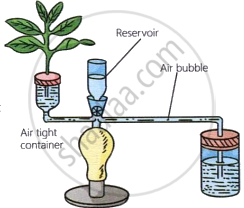
- The diagram given alongside is an apparatus used to study a particular phenomenon in plants.
- Name the apparatus.
- What is it used for?
- What is the role played by the air bubble in this experiment?
- Of what use is the reservoir?
- What happens to the movement of the air-bubble if the apparatus is kept
- in dark,
- in sunlight,
- in front of fan?
Give a reason in each case.
The diagram represents an experiment to demonstrate a certain phenomenon in a green plant.
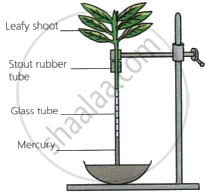
- Has the level of mercury in the glass tube risen or fallen?
- Name the life process of the plant which has caused the change in the level of mercury.
- Define the process named above.
- State any three advantages of this process to the plant.
- Which conducting tissue of the plant does the glass tube represent - xylem or phloem?
The figure below represents the set-up at the start of certain experiment to demonstrate an activity of plants:
(i) What is the aim of the experiment?
(ii) Why has oil been put in each test tube?
(iii) What will be the observations in the two test-tubes after about 2-3 days?
(iv) Give reasons to explain any change observed as answered in (iii) above.
(v) Why has the test-tube b without the plant, been taken in the experiment?

A well watered healthy potted plant with variegated leaves was kept in darkness for about 24 hours. It was then set up as shown in the diagram and exposed to light for about 12 hours. At the end of this time, leaf x and y were tested for starch. Study the diagram and answer the questions that follow:
(i) Why was the plant initially kept in darkness for 24 hours?
(ii) What is the function of sodium hydroxide solution in the flask?
(iii) Select the correct leaf from the five available choices shown in the diagram as a, b, c, d and e. Rewrite the correct answer by filling in the appropriate letter for the questions that follow:
1. After the starch test, leaf x would look like ______.
2. After the starch test, leaf y would look like ______.
(iv) The experiment with leaf y shows that photosynthesis requires the presence of certain factors. Mention any one factor.

The apparatus shown here is Ganong's photometer designed to demonstrate unequal transpiration from the two surfaces of a dorsiventral leaf. Before keeping the leaf in between the cups, anhydrous calcium chloride (CaCl2) contained in two small vials were weighted and placed in both the cups. The ends of the cups were weighted and with corks through which two mercury manometers were connected. After a few hours, CaCl2 vials were taken out and weighed again.
(i) What is the purpose of keeping CaCl2 vials inside the cup?
(ii) After a few hours, CaCl2 vials were taken out and weighed again.
will you except any difference in weight? If so, give reasons.
(iii) What was expect the purpose of using a manometer?
(iv) What do you mean by transpiration?

Fig. represents a structure found in a leaf. Study the same and answer the questions that follow:
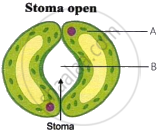
- Name the parts labelled A and B.
- What is the biological term for the above structure?
- What is the function of the part labelled A?
- Mention two structural features of A, which help in the function mentioned in (c) above?
- Where is this structure likely to be found in a leaf?
- The structure helps in the process of transpiration. Explain the term transpiration.
Fig. shows an experimental set-up to demonstrate a particular physiological process. Study the same and answer the questions that follow:
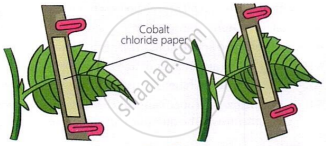
- Name the physiological process being studied.
- Explain the process mentioned above.
- What is the aim of the above experiment?
- What would you observe in the experimental set-up after an hour? Give a reason to support your answer.
- Mention any three adaptations found in plants to overcome the physiological process mentioned in (a) above.
An apparatus, as shown below, was set up to investigate a physiological process in plants. The setup was kept in sunlight for two hours. Droplets of water were then seen inside the bell jar. Answer the questions that follow:

- Name the process being studied.
- Explain the process named above in Q.3(a)(i).
- Why was the pot covered with a plastic sheet?
- Suggest a suitable control for this experiment.
- Mention two ways in which this process is beneficial to plants.
- List three adaptations in plants to reduce the above mentioned process.
Fig. demonstrates a particular process in plants. Study the same and answer the questions that follow:
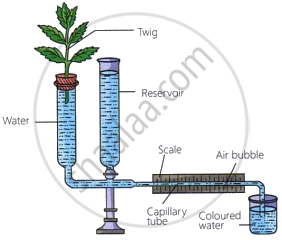
- Name the apparatus.
- Which phenomenon is demonstrated by this apparatus?
- Explain the phenomenon mentioned in (b) above.
- State two limitations of using this apparatus.
- What is the importance of the air bubble in the experiment?
Fig. represents aprocess in plants. The set up was placed in bright sunlight. Answer the following questions:
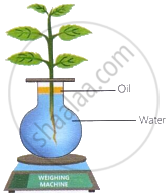
-
- Name the physiological process depicted in the figure.
- Why was oil added to the water?
- When placed in bright sunlight for four hours, what do you observe with regard to the initial and final weight of the plant? Give a suitable reason for your answer.
- What happens to the level of water when this setup is placed in:
- Humid conditions?
- Windy conditions?
- Mention any three adaptations found in plants to overcome the process mentioned in (a).
- Explain the term ‘Guttation’.
Leaves of certain plants roll up on a hot sunny day. Explain by giving suitable reasons.
Define the following term:
Transpiration
Enlist different advantages of transpiration.
Write any two limitations of using a Ganong's potometer to demonstrate the uptake of water.
Given below is an apparatus which was setup to investigate a physiological process in plants. The setup was placed in bright sunlight. Answer the questions that follow:
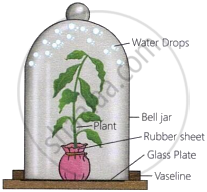
- Name the process being studied. Define the process.
- Why was the pot enclosed in a rubber sheet?
- Mention two external factors which can accelerate the above process.
- List two adaptations in plants to reduce the above process.
- Draw a neat, labelled diagram of a stomatal apparatus.
The diagram below represents an experiment to demonstrate a certain phenomenon in a green plant:
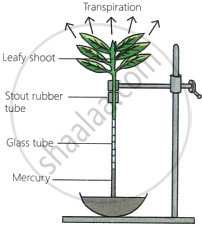
- Will the level of mercury in the glass tubing rise off all?
Which conducting tissue of the plant does the glass-tubing represent? - Define transpiration.
- How will the rate of the above process differ if the environment of the plant has:
- less humidity?
- high temperature?
- State any two advantages of transpiration to the plant.
- Draw a neat, labelled diagram of a plasmolysed cell.
Solutions for 5: Transpiration
Frank solutions for बायोलॉजी पार्ट २ [अंग्रेजी] कक्षा १० आईएससी chapter 5 - Transpiration
Shaalaa.com has the CISCE Mathematics बायोलॉजी पार्ट २ [अंग्रेजी] कक्षा १० आईएससी CISCE solutions in a manner that help students grasp basic concepts better and faster. The detailed, step-by-step solutions will help you understand the concepts better and clarify any confusion. Frank solutions for Mathematics बायोलॉजी पार्ट २ [अंग्रेजी] कक्षा १० आईएससी CISCE 5 (Transpiration) include all questions with answers and detailed explanations. This will clear students' doubts about questions and improve their application skills while preparing for board exams.
Further, we at Shaalaa.com provide such solutions so students can prepare for written exams. Frank textbook solutions can be a core help for self-study and provide excellent self-help guidance for students.
Concepts covered in बायोलॉजी पार्ट २ [अंग्रेजी] कक्षा १० आईएससी chapter 5 Transpiration are Measurement of Transpiration > Weighing Method, Factors Affecting the Rate of Transpiration, Plant Adaptations to Reduce Transpiration, Significance of Transpiration, Guttation and Bleeding, Demonstration of Transpiration, Measurement of Transpiration > Potometer Method, Types of Transpiration > Stomatal Transpiration, Types of Transpiration > Cuticular Transpiration, Types of Transpiration > Lenticular Transpiration, Traspiration Vs Bleeding, Measurement of Transpiration > Weighing Method, Factors Affecting the Rate of Transpiration, Plant Adaptations to Reduce Transpiration, Significance of Transpiration, Guttation and Bleeding, Demonstration of Transpiration, Measurement of Transpiration > Potometer Method, Types of Transpiration > Stomatal Transpiration, Types of Transpiration > Cuticular Transpiration, Types of Transpiration > Lenticular Transpiration, Traspiration Vs Bleeding.
Using Frank बायोलॉजी पार्ट २ [अंग्रेजी] कक्षा १० आईएससी solutions Transpiration exercise by students is an easy way to prepare for the exams, as they involve solutions arranged chapter-wise and also page-wise. The questions involved in Frank Solutions are essential questions that can be asked in the final exam. Maximum CISCE बायोलॉजी पार्ट २ [अंग्रेजी] कक्षा १० आईएससी students prefer Frank Textbook Solutions to score more in exams.
Get the free view of Chapter 5, Transpiration बायोलॉजी पार्ट २ [अंग्रेजी] कक्षा १० आईएससी additional questions for Mathematics बायोलॉजी पार्ट २ [अंग्रेजी] कक्षा १० आईएससी CISCE, and you can use Shaalaa.com to keep it handy for your exam preparation.
