Advertisements
Advertisements
प्रश्न
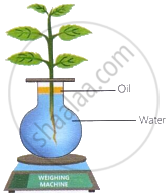
Fig. represents aprocess in plants. The set up was placed in bright sunlight. Answer the following questions:
-
- Name the physiological process depicted in the figure.
- Why was oil added to the water?
- When placed in bright sunlight for four hours, what do you observe with regard to the initial and final weight of the plant? Give a suitable reason for your answer.
- What happens to the level of water when this setup is placed in:
- Humid conditions?
- Windy conditions?
- Mention any three adaptations found in plants to overcome the process mentioned in (a).
- Explain the term ‘Guttation’.
Advertisements
उत्तर
-
- Transpiration
- Oil was added to the water to prevent its evaporative loss.
- Upon exposure to bright sunlight for four hours, the final weight will be less than the initial weight because some water will be lost from the aerial parts of the plant by transpiration.
-
- When this setup is placed in humid conditions, there is no change in the level of water.
- When this setup is placed in humid conditions, the level of water drops.
-
The three adaptations found in plants to overcome transpiration are:
- Sunken stomata: The stomata may be sunken or covered by hairs (eg. Nerium)
- Narrow leaves: The leaves may become narrower to reduce surface area.
- Fewer stomata: The number of stomata may be reduced.
- Plants growing in a moist, warm soil and under humid conditions possess specialised structures called hydathodes on tips and margins of leaves. Water escapes in liquid form at night and accumulates in drops at the hydathodes. This process is known as guttation.
Guttation usually occurs at night when transpiration has stopped, and the rate of absorption is high. Under these conditions, root pressure is highest, forcing water upward through the xylem elements and eventually exuding as drops from hydathodes near the leaf margins.
Guttation can also occur during daytime if plants are situated in damp and warm soils or in humid conditions, hence increasing root pressure.
Guttation is commonly observed around the tips and margins of leaves in grasses, wheat, rye, barley, nasturtium, Colocasia, and tomato during the early morning following a humid and warm night.
APPEARS IN
संबंधित प्रश्न
Give the equivalent term for the following:
The condition in which the cell contents are shrunken.
Give reasons for the following:
If you sprinkle some common salt on grass growing on a lawn, it is killed at that spot.
Give suitable biological reasons for the following statement:
Root hairs become flaccid and droop when excess fertilizers are added to the moist soil around them.
Mention whether the following statement is true (T) or false (F) and give an explanation in support of your answer.
Soaked seeds burst into three seed coats.
Differentiate between:
Turgid and Flaccid.
Name the following:
The process by which wilting or drooping of leaves occurs.
Mention, if the following statement is True or False. If false rewrite the wrong statement in its correct form:
Flaccidity is the reverse of turgidity.
Give the equivalent term for the following:
Pressure exerted by the cell contents on the cell wall.
The figure given below is a diagrammatic representation of a part of the cross-section of the root in the root hair zone. Study the same and then answer the questions that follow:

- The parts labelled as 1, 2, 3 and 4 are:
- Root hair, Xylem vessel, Soil particles, Cortex respectively.
- Xylem vessel, Soil particles, Root hair, Cortex respectively.
- Root hair, Xylem vessel, Cortex, Soil particles respectively.
- Cortex, Soil particles, Xylem vessel, Root hair respectively.
- The process that enables the passage of water from soil into the root hair is:
- Diffusion
- Active transport
- Osmosis
- Passive absorption
- The kind of force which exists between a liquid and any surface is called as:
- Cohesive force
- Adhesive force
- Capillarity
- Suction force
- The kind of force between the same kind of liquid molecules is:
- Capillary force
- Transpirational pull
- Adhesive force
- Cohesive force
- Sometimes exudation of water occurs from the margin of the leaves in the early morning or night. It is termed as:
- Transpiration
- Guttation
- Bleeding
- Osmosis
Given below is the figure of a plant cell showing different kinds of pressure acting upon it. Study the figure and answer the questions that follow:

- In the figure, 1, 2 and 3 represent:
- Cytoplasm, Nucleus, Vacuole respectively
- Vacuole, Cytoplasm, Cell wall respectively.
- Cytoplasm, Cell membrane and vacuole respectively.
- Cytoplasm, Cell wall and Vacuole respectively.
- B in the figure represents:
- Osmotic pressure
- Turgor pressure
- Wall pressure
- Diffusion pressure
- A in the figure represents:
- irnbibition pressure
- Wall pressure
- Turgor pressure
- Osmotic pressure
- C in the figure represents:
- Turgor pressure
- Osmotic pressure
- Wall pressure
- Imbibition pressure
- Draw a neat and labelled diagram of a plasmolyzed plant cell.
