Advertisements
Advertisements
प्रश्न
Excessive use of fertilisers in agricultural fields reduces the yield of crops. Justify the statement.
Advertisements
उत्तर
The excessive use of fertilizers in agriculture increases the concentration of solvents outside of the root cells, which causes exosmosis. The state of the crops becomes plasmolysis/Flaccid, which results in a diminishing yield.
संबंधित प्रश्न
A plant cell may burst when :
Give scientific reasons : Balsam plants wilt during mid-day even if the soil is well watered.
Fig. represents aprocess in plants. The set up was placed in bright sunlight. Answer the following questions:
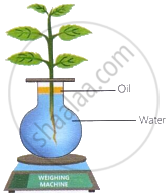
-
- Name the physiological process depicted in the figure.
- Why was oil added to the water?
- When placed in bright sunlight for four hours, what do you observe with regard to the initial and final weight of the plant? Give a suitable reason for your answer.
- What happens to the level of water when this setup is placed in:
- Humid conditions?
- Windy conditions?
- Mention any three adaptations found in plants to overcome the process mentioned in (a).
- Explain the term ‘Guttation’.
Give reasons for the following:
If you sprinkle some common salt on grass growing on a lawn, it is killed at that spot.
Give suitable biological reasons for the following statement:
Root hairs become flaccid and droop when excess fertilizers are added to the moist soil around them.
Distinguish between the following:
Flaccid condition and turgid condition
Differentiate between:
Turgid and Flaccid.
Name the following:
The process by which wilting or drooping of leaves occurs.
Deplasmolysis occurs when a plasmolysed cell is placed in ______.
