Advertisements
Advertisements
प्रश्न
Distinguish between the following:
Flaccid condition and turgid condition
Advertisements
उत्तर
| Flaccid condition | turgid condition |
| The cell in the state of plasmolysis is said to be flaccid . | When a cell reaches a state when it cannot accommodate any more water i.e. it is fully distended , it is called turgid . |
APPEARS IN
संबंधित प्रश्न
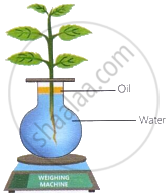
Fig. represents aprocess in plants. The set up was placed in bright sunlight. Answer the following questions:
-
- Name the physiological process depicted in the figure.
- Why was oil added to the water?
- When placed in bright sunlight for four hours, what do you observe with regard to the initial and final weight of the plant? Give a suitable reason for your answer.
- What happens to the level of water when this setup is placed in:
- Humid conditions?
- Windy conditions?
- Mention any three adaptations found in plants to overcome the process mentioned in (a).
- Explain the term ‘Guttation’.
Give reasons for the following:
If you sprinkle some common salt on grass growing on a lawn, it is killed at that spot.
A leaf cell of a water plant was placed in a liquid other than pond water. After sometime, it assumed a shape as shown below:
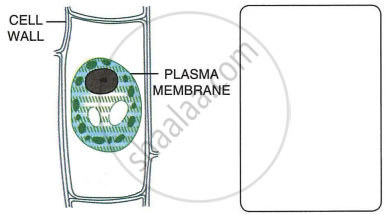
- Give the term for the state of the cell it has acquired.
- Name the structure which acts as a selectively permeable membrane.
- Comment on the nature (tonicity) of the liquid surrounding the cell.
- Name any one feature of this plant cell which is not present in an animal cell.
- Redraw in the space provided, the diagram of the cell if it is soon placed in ordinary water for some time.
Differentiate between:
Turgid and Flaccid.
Differentiate between the following:
Plasmolysis and Deplasmolysis.
Give Technical Term for the following.
The pressure exerted by cell contents on a plant cell wall.
Multiple Choice Question:
When cell is fully turgid, which of the following will be zero?
Excessive use of fertilisers in agricultural fields reduces the yield of crops. Justify the statement.
Give the equivalent term for the following:
Pressure exerted by the cell contents on the cell wall.
The figure given below is a diagrammatic representation of a part of the cross-section of the root in the root hair zone. Study the same and then answer the questions that follow:

- The parts labelled as 1, 2, 3 and 4 are:
- Root hair, Xylem vessel, Soil particles, Cortex respectively.
- Xylem vessel, Soil particles, Root hair, Cortex respectively.
- Root hair, Xylem vessel, Cortex, Soil particles respectively.
- Cortex, Soil particles, Xylem vessel, Root hair respectively.
- The process that enables the passage of water from soil into the root hair is:
- Diffusion
- Active transport
- Osmosis
- Passive absorption
- The kind of force which exists between a liquid and any surface is called as:
- Cohesive force
- Adhesive force
- Capillarity
- Suction force
- The kind of force between the same kind of liquid molecules is:
- Capillary force
- Transpirational pull
- Adhesive force
- Cohesive force
- Sometimes exudation of water occurs from the margin of the leaves in the early morning or night. It is termed as:
- Transpiration
- Guttation
- Bleeding
- Osmosis
