Advertisements
Advertisements
प्रश्न
Differentiate between the following
Turgor pressure and Root pressure
Advertisements
उत्तर
| Turgor Pressure | Root Pressure |
| t is the pressure of the cell. Contents of a turgid cell on its cell wall. | It is the pressure under which water passes from the living cells into the xylem of root. |
| It is caused when a cell becomes turgid. | It is caused due to alternate turgidity and flaccidity of root cells. |
संबंधित प्रश्न
Give scientific reasons : Balsam plants wilt during mid-day even if the soil is well watered.
Give the equivalent term for the following:
Loss of water through a cut stem.
Mention whether the following statement is true or false Correct the false statement by altering the last word only.
Cells that have lost their water content are said to be deplasmolysed.
Give reason for the following:
A plant cell, when kept in a hypertonic salt solution for about 30 minutes, turns flaccid.
A leaf cell of a water plant was placed in a liquid other than pond water. After sometime, it assumed a shape as shown below:
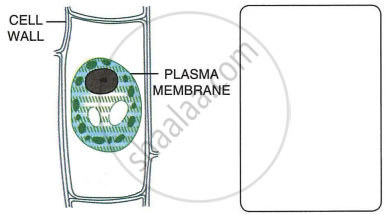
- Give the term for the state of the cell it has acquired.
- Name the structure which acts as a selectively permeable membrane.
- Comment on the nature (tonicity) of the liquid surrounding the cell.
- Name any one feature of this plant cell which is not present in an animal cell.
- Redraw in the space provided, the diagram of the cell if it is soon placed in ordinary water for some time.
Differentiate between:
Turgid and Flaccid.
Multiple Choice Question:
When cell is fully turgid, which of the following will be zero?
Deplasmolysis occurs when a plasmolysed cell is placed in ______.
When the cells of a plant are fully distended, the condition is called ______.
