Advertisements
Advertisements
प्रश्न
A leaf cell of a water plant was placed in a liquid other than pond water. After sometime, it assumed a shape as shown below:
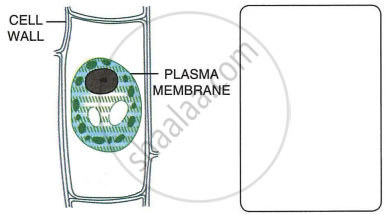
- Give the term for the state of the cell it has acquired.
- Name the structure which acts as a selectively permeable membrane.
- Comment on the nature (tonicity) of the liquid surrounding the cell.
- Name any one feature of this plant cell which is not present in an animal cell.
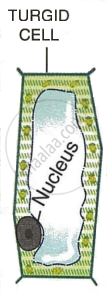
- Redraw in the space provided, the diagram of the cell if it is soon placed in ordinary water for some time.
Advertisements
उत्तर
- Flaccid Cell (Plasmolysis)
- Plasma membrane
- Hypertonic solution
- Presence of cell wall
APPEARS IN
संबंधित प्रश्न
The diagram given below represents a plant cell after being placed in a strong sugar solution. Study the diagram and answer the questions that follow:

- What is the state of the cell shown in the diagram?
- Name the structure that acts as a selectively permeable membrane.
- Label the parts numbered 1 to 4 in the diagram.
- How can the above cell be brought back to its original condition? Mention the scientific term for the recovery of the cell.
- State any two features of the above plant cell which is not present in animal cells.
The state of a cell in which the cell wall is rigid and stretched by the increase in volume due to the absorption of water is called.
Give the equivalent term for the following:
Loss of water through a cut stem.
What is the difference between ‘flaccid’ and ‘turgid’? Give one example of flaccid condition in plants.
Distinguish between the following:
Flaccid condition and turgid condition
Differentiate between the following
Turgor pressure and Root pressure
Give Technical Term for the following.
The pressure exerted by cell contents on a plant cell wall.
Name the following:
The condition in which the contents of a cell exert pressure against the cell wall making it distended.
Addition of salt to pickles is a method of killing the bacteria by ______.
Give the equivalent term for the following:
Pressure exerted by the cell contents on the cell wall.
