Advertisements
Advertisements
प्रश्न
The diagram given below represents an experimental set-up to demonstrate a certain process. Study the same and answer the questions that follow:
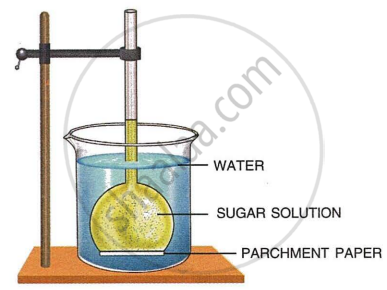
- Name the process.
- Define the above-named process.
- What would you observe in the experimental set-up after an hour or so?
- What control experiment can be set up for comparison?
- Keeping in mind the root hair, cell and its surroundings, name the parts that correspond to
- concentrated sugar solution
- parchment paper
- water in the beaker
- Name any other material that can be used instead of parchment paper in the above experiment.
- Mention two advantages of the process for the plants.
Advertisements
उत्तर
- The process is osmosis.
- Osmosis is the flow of water molecules from their greater concentration towards their lower concentration across a semi-permeable membrane.
- An hour or so later, you will see that the level of liquid in the vertical tube has raised as a result of osmosis-mediated water entering the tube via the goat bladder.
- Take another thistle funnel filled with simple water and suspend it in another beaker, likewise holding water as a control for comparison. Mark the level on its stem.
- The thistle funnel's liquid level in the control will not change after a few hours.
- While in the beaker in control will remain the same, the water level in the experiment's beaker will somewhat drop.
- Should one taste the water from the experiment's beaker, it is not sweet.
-
- Root hairs are components of root cells, so they correspond to the cell.
- The cell resembles parchment paper.
- The cell's surroundings match water in a beaker.
- Cellophane can be used.
-
- It is important for water absorption from the ground.
- It results in turgidity of the cells, which is crucial for preserving the form and structure of many organ components of a plant.
APPEARS IN
संबंधित प्रश्न
The highest water potential (capacity to move out higher concentrated solution) is that of ______.
Give the equivalent terms for the following:
Pressure of the cell contents on the cell wall
Give two examples of turgor movements in plants.
Explain how soaked seeds swell up and burst their seed coats.
The following diagram represents a plant cell after being placed in a strong sugar solution.
 Guidelines 1 to 5 indicate the following
(1)Cell wall, (2) Strong sugar solution, (3) Protoplasm (4) Large vacuole, (5) Nucleus
(1)What is the state of the cell shown in the cell shown in the diagram?
(2)Name the structure which acts as a selectively permeable membrane.
(3)If the cell had been placed in distilled water instead of strong sugar solution, which feature would not have been seen?
(4)Name any one feature of this plant cell which is not present in an animal cell.
Differentiate between:
Osmosis and Diffusion
Give a diagrammatic representation of plasmolysis in a cell.
A plant cell kept in a drop of water was examined under the low power magnification of a microscope, as shown:
(i) What would you do to bring this cell back to its original condition?
(ii) What scientific term is used for such condition?
(iii) Draw the same cell if it is kept in a strong sugar solution.
In an experiment, two sets of apparatus were set up as shown below:
In A there is a concentrated sugar solution inside the thistle funnel and red ink in the water outside the funnel. In B there is a concentrated glucose solution with red ink inside the thistle funnel and water outside the thistle funnel.
In both A and B the level of liquid inside the funnels rises up the tubes. In A the sugar solution turns red and in B, the water turns red.
Study the given observations and answer these questions:

- Name the process by which red ink moves in A and B.
- Which type of pressure forces the water molecules to move towards thistle funnels and cause a rise in the water level?
- Where does this process occur in plants and animals?
- What material could be used as a semi-permeable membrane?
The beaker is divided into two chambers A and B. The big circle represents solute and the small circles solvent.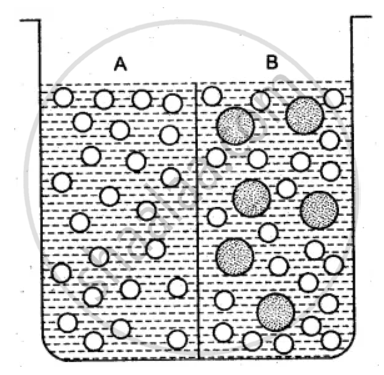
(i) What can you say about the size of the holes in the membrane, if it is to behave semi- permeably between these two?
(ii) Will the solvent molecules pass through the membrane from left to right, from right to left, in either direction or in both directions?
(iii) In which direction will there be a net movement of solvent molecules?
