Advertisements
Advertisements
प्रश्न
The diagram given below represents an experimental set-up to demonstrate a certain process. Study the same and answer the questions that follow:
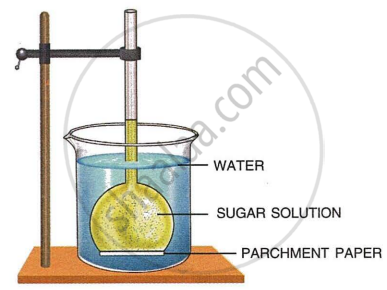
- Name the process.
- Define the above-named process.
- What would you observe in the experimental set-up after an hour or so?
- What control experiment can be set up for comparison?
- Keeping in mind the root hair, cell and its surroundings, name the parts that correspond to
- concentrated sugar solution
- parchment paper
- water in the beaker
- Name any other material that can be used instead of parchment paper in the above experiment.
- Mention two advantages of the process for the plants.
Advertisements
उत्तर
- The process is osmosis.
- Osmosis is the flow of water molecules from their greater concentration towards their lower concentration across a semi-permeable membrane.
- An hour or so later, you will see that the level of liquid in the vertical tube has raised as a result of osmosis-mediated water entering the tube via the goat bladder.
- Take another thistle funnel filled with simple water and suspend it in another beaker, likewise holding water as a control for comparison. Mark the level on its stem.
- The thistle funnel's liquid level in the control will not change after a few hours.
- While in the beaker in control will remain the same, the water level in the experiment's beaker will somewhat drop.
- Should one taste the water from the experiment's beaker, it is not sweet.
-
- Root hairs are components of root cells, so they correspond to the cell.
- The cell resembles parchment paper.
- The cell's surroundings match water in a beaker.
- Cellophane can be used.
-
- It is important for water absorption from the ground.
- It results in turgidity of the cells, which is crucial for preserving the form and structure of many organ components of a plant.
APPEARS IN
संबंधित प्रश्न
Two potato cubes each 1 cm3 in size, were placed separately in two containers (A&B), the container (A) having water and the other (B) containing concentrated sugar solution. After 24 hours when the cubes were examined, those placed in water were found to be firm and had increased slightly in size and those placed in concentrated sugar solution were found to be soft and had somewhat decreased in size. Use the above information to answer the questions that follow:
Account for the firmness and increase in the size of the potato cubes placed in water.
A leaf cell of a water plant was placed in a liquid other than pond water. After sometime, it assumed a shape as shown below:
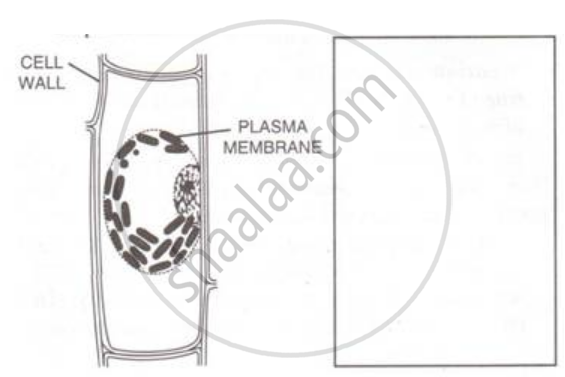
Comment on the nature (tonicity) of the liquid surrounding the cell.
Give Reasons for the following.
It is necessary to maintain a normal osmotic concentration of the blood.
Give Reasons for the following.
The raisins swell up in the water.
Give Reasons for the following.
Freshwater fish cannot survive in seawater.
Give Reasons for the following.
Plants begin to die when the excess of soluble fertilizers are added to the soil?
Fill in the Blank
When there is no movement of water in the cell from the outside medium, the medium is considered to be ______ to cell sap.
Fill in the Blanks
Diffusion is the movement of molecules from a region of their ________ concentration to the region of their ________ concentration.
Name the two organelles in a plant cell that contain their own genetic material and ribosomes.
