Advertisements
Advertisements
प्रश्न
The apparatus arranged here signifies an important process.
(i) Name the process.
(ii) Where does this process occur in plants?
(iii) What solution is placed inside the dialysis tubing?
(iv) What happens to the level of the solution in the capillary tube?
(v) Define the process mentioned in Q. (i) above.
Advertisements
उत्तर
(1) The process is called osmosis.
(ii) This process occurs in the root hair cells of plants.
(iii) The solution placed inside the dialysis tubing is generally strong sugar solution or salt solution.
(iv) The level of the solution in the capillary tube rises above the original level.
(v) Osmosis is a physiological process where the water molecules or solvent molecules move through a semi-permeable membrane from a solution having a higher concentration of solvent molecules to the solution having a lower concentration of water or solvent molecules.
संबंधित प्रश्न
Show by a series of diagrams, the change which a plant cell will undergo when placed in
Hypotonic salt solution
The diagram given below is of an experiment just at the start. Study the diagram carefully and answer the following questions :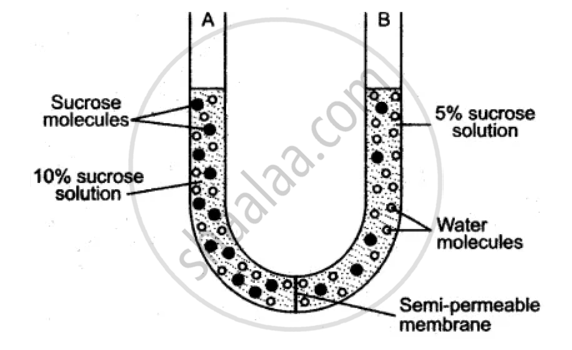
(i) What does the experiment demonstrate?
(ii) Define, the process demonstrated in the experiment.
(iii) What changes are observed after a few hours?
(iv) Give two examples of a semi-permeable membrane.
(v) Which limb of the U-tube contains a more concentrated sucrose solution, A or B?
(vi) Why is the membrane separating the two solutions labeled as semi-permeable membrane?
A plant cell kept in a drop of water was examined under the low power magnification of a microscope, as shown:
(i) What would you do to bring this cell back to its original condition?
(ii) What scientific term is used for such condition?
(iii) Draw the same cell if it is kept in a strong sugar solution.
Give Technical Term for the following.
A solution whose concentration is greater than that of the cell sap.
Give Technical Term for the following.
The pressure which is responsible for the movement of water molecules across the cortical cells of the root.
Name the following:
The movement of a liquid through a selectively permeable membrane.
Name the following:
The process by which raisins swell up when placed in a beaker of water.
Fill in the Blank
Raisin swells up when kept in a __________ solution.
Fill in the Blanks
Diffusion is the movement of molecules from a region of their ________ concentration to the region of their ________ concentration.
Fill in the Blanks
Osmosis in the diffusion of _______ molecules from the region of higher _____ potential to that of lower potential across a S.P.M.
