Advertisements
Advertisements
प्रश्न
Differentiate between the following:
Plasmolysis and deplasmolysis
Advertisements
उत्तर
| Plasmolysis | Deplasmolysis | ||
| 1 | It refers to the shrinkage of the cytoplasm and withdrawal of the plasma membrane from the cell wall caused due to the withdrawal of water when placed in a hypertonic solution. | 1 | Deplasmolysis is the recovery of a plasmolysed cell when it is placed in water, wherein the cell's protoplasm again swells up due to the re-entry of water. |
| 2 | In Plasmolysis, the cell becomes flaccid. | 2 | In deplasmolysis, the cell becomes turgid. |
संबंधित प्रश्न
The space between the cell wall and plasma membrane in a plasmolysed cell is filled with ______.
Mention whether the following statement is true (T) or false (F) and give explanation in support of your answer.
Plasmolysis is reverse of deplasmolysis.
A leaf cell of a water plant was placed in a liquid other than pond water. After sometime, it assumed a shape as shown below:
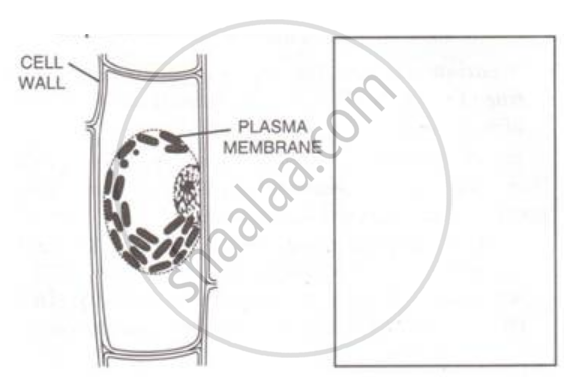
Comment on the nature (tonicity) of the liquid surrounding the cell.
What is the significance of diffusion?
In the figure below ‘A’ shows a cell in the normal state and ‘B’ shows the same cell after leaving it in a certain solution for a few minutes.

(i) Describe the change which has occurred in the cell as seen in B.
(ii) Give the technical term for the condition of the cell as reached in B and as it was in A.
(iii) Define the process which led to this condition.
(iv) What was the solution-isotonic, hypotonic or hypertonic, in which the cell was kept?
(v) How can the cell in B, be brought back to its original condition?
(vi) Name the parts numbered 1 to 3.
The diagram below represents an experimental set up to demonstrate a vital process. Study the same and then answer the questions that follow:
(i) Name the process.
(ii) Define the above named process.
(iii) What would you observe in the experimental setup after an hour or so?
(iv) What control experiment can be set up for the above experiment?
(v) Keeping in mind the root hair cell and its surrounding name the part that corresponds to (1) Concentrated sugar solution, (2) Parchment paper, (3) Water in the beaker.
(vi) Name any other substance that can be used instead of parchment paper in the above experiment.
(vii) Mention two advantages of this process to the plant.
Give Technical Term for the following.
A solution whose concentration is equal to the cell sap.
Name the following:
Condition of cell in which the cell content are shrunken.
Fill in the Blanks
Osmosis in the diffusion of _______ molecules from the region of higher _____ potential to that of lower potential across a S.P.M.
