Advertisements
Advertisements
प्रश्न
A plant cell kept in a drop of water was examined under the low power magnification of a microscope, as shown:
(i) What would you do to bring this cell back to its original condition?
(ii) What scientific term is used for such condition?
(iii) Draw the same cell if it is kept in a strong sugar solution.
Advertisements
उत्तर
(i) Put the cell back into the drop of water for sometime. Deplasmolysis occurs.
(ii) Plasmolysis.
(iii) Plasmolysed cell.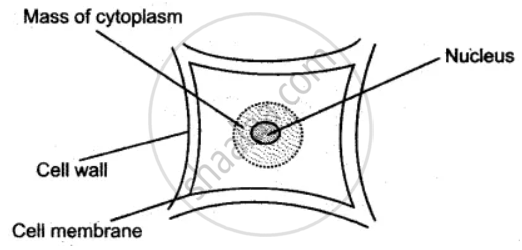
संबंधित प्रश्न
Differentiate between Diffusion and Osmosis (Definition)
The highest water potential (capacity to move out higher concentrated solution) is that of ______.
Explain why:
Bacteria and fungi do not grow in pickles, jams, jellies and squashes.
Mention whether the following statement is true (T) or false (F) and give explanation in support of your answer.
Plasmolysis is reverse of deplasmolysis.
Give Reasons for the following.
Plants growing in fertilized soil are often found to wilt if the soil is not adequately watered. Why?
Name the following:
The movement of a liquid through a selectively permeable membrane.
Fill in the Blank
When there is no movement of water in the cell from the outside medium, the medium is considered to be ______ to cell sap.
Fill in the Blank
A plasmolysed cell has __________ protoplast.
Mention, if the following statement is True or False. If false rewrite the wrong statement in its correct form:
Cells that have lost their water content are said to be deplasmolysed.
Define the following term:
Osmotic Pressure
