Advertisements
Advertisements
प्रश्न
Fill in the Blank
A plasmolysed cell has __________ protoplast.
Advertisements
उत्तर
A plasmolysed cell has Shrunken protoplast.
संबंधित प्रश्न
The space between the cell wall and plasma membrane in a plasmolysed cell is filled with ______.
Give the equivalent terms for the following:
Pressure of the cell contents on the cell wall
Explain how soaked seeds swell up and burst their seed coats.
Show by a series of diagrams, the change which a plant cell will undergo when placed in
Hypotonic salt solution
Name the following:
The inward movement of solvent molecules through the plasma membrane of the cell.
Name the following:
The process by which raisins swell up when placed in a beaker of water.
Explain why:
The leaves of wilted lettuce, if kept in cold water, become crisp.
The beaker is divided into two chambers A and B. The big circle represents solute and the small circles solvent.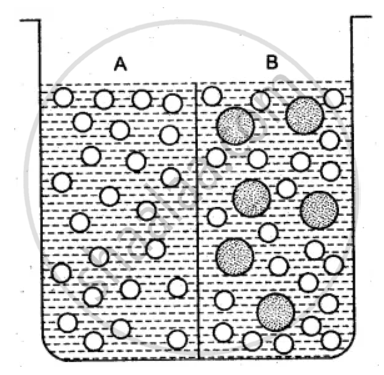
(i) What can you say about the size of the holes in the membrane, if it is to behave semi- permeably between these two?
(ii) Will the solvent molecules pass through the membrane from left to right, from right to left, in either direction or in both directions?
(iii) In which direction will there be a net movement of solvent molecules?
Name the following:
The process by which raisins swell up when placed in a beaker of water.
Fill in the Blanks
Osmosis in the diffusion of _______ molecules from the region of higher _____ potential to that of lower potential across a S.P.M.
