Advertisements
Advertisements
Question
A plant cell kept in a drop of water was examined under the low power magnification of a microscope, as shown:
(i) What would you do to bring this cell back to its original condition?
(ii) What scientific term is used for such condition?
(iii) Draw the same cell if it is kept in a strong sugar solution.
Advertisements
Solution
(i) Put the cell back into the drop of water for sometime. Deplasmolysis occurs.
(ii) Plasmolysis.
(iii) Plasmolysed cell.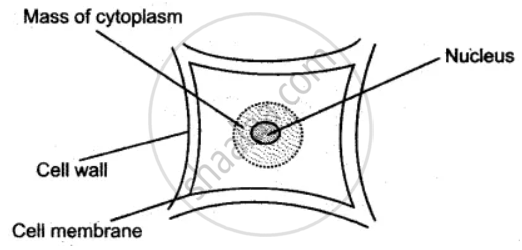
RELATED QUESTIONS
A candidate in order to study the process of osmosis has taken 3 potato cubes and put them in 3 different beakers containing 3 different solutions. After 24 hours, in the first beaker the potato cube increased in size, in the second beaker the potato cube decreased in size and in the third beaker there was no change in the size of the potato cube. The following diagram shows the result of the same experiment:

(i) Give the technical terms of the solutions used in beakers, 1, 2 and 3.
(ii) In beaker 3, the size of the potato cube remains the same. Explain the reason in brief.
(iii) Write the specific feature of the cell sap of root hairs which helps in absorption of water.
(iv) What is osmosis?
(v) How does a cell wall and a cell membrane differ in their permeability?
What do you mean by transpiration pull ?
The beaker is divided into two chambers A and B. The big circle represents solute and the small circles solvent.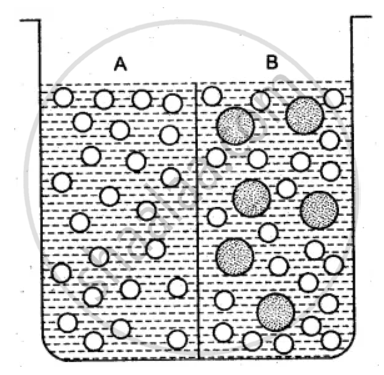
(i) What can you say about the size of the holes in the membrane, if it is to behave semi- permeably between these two?
(ii) Will the solvent molecules pass through the membrane from left to right, from right to left, in either direction or in both directions?
(iii) In which direction will there be a net movement of solvent molecules?
Name the following:
The movement of a liquid through a selectively permeable membrane.
Fill in the Blank
When there is no movement of water in the cell from the outside medium, the medium is considered to be ______ to cell sap.
Mention, if the following statement is True or False. If false rewrite the wrong statement in its correct form:
The plasma membrane permits the passage of all solutes and water.
Multiple Choice Question:
Osmosis involves:
Explain the term:
Plasmolysis
Define the following term:
Tonicity
