English

A Leaf Cell of a Water Plant Was Placed in a Liquid Other than Pond Water. After Sometime, It Assumed a Shape as Shown Below: - Biology

Advertisements
Advertisements

Question

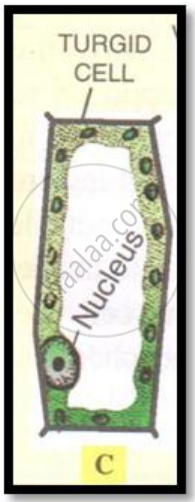
A leaf cell of a water plant was placed in a liquid other than pond water. After sometime, it assumed a shape as shown below: 

Redraw in the space provided, the diagram of the cell if it is soon placed in ordinary water for some time.

Diagram
Advertisements

Solution

shaalaa.com
  Is there an error in this question or solution?

Video TutorialsVIEW ALL [1]

RELATED QUESTIONS

Define the following:

Hypertonic solution


Distinguish between the following:

Plasmolysis and deplasmolysis


Choose the correct answer:

Cell turgidity is caused by _______________


Give Reasons for the following.
The raisins swell up in the water.


In the figure below ‘A’ shows a cell in the normal state and ‘B’ shows the same cell after leaving it in a certain solution for a few minutes.


(i) Describe the change which has occurred in the cell as seen in B.
(ii) Give the technical term for the condition of the cell as reached in B and as it was in A.
(iii) Define the process which led to this condition.
(iv) What was the solution-isotonic, hypotonic or hypertonic, in which the cell was kept?
(v) How can the cell in B, be brought back to its original condition?
(vi) Name the parts numbered 1 to 3.


A plant cell kept in a drop of water was examined under the low power magnification of a microscope, as shown:

(i) What would you do to bring this cell back to its original condition?
(ii) What scientific term is used for such condition?
(iii) Draw the same cell if it is kept in a strong sugar solution.


The diagram below represents an experimental set up to demonstrate a vital process. Study the same and then answer the questions that follow:


(i) Name the process.
(ii) Define the above named process.
(iii) What would you observe in the experimental setup after an hour or so?
(iv) What control experiment can be set up for the above experiment?
(v) Keeping in mind the root hair cell and its surrounding name the part that corresponds to (1) Concentrated sugar solution, (2) Parchment paper, (3) Water in the beaker.
(vi) Name any other substance that can be used instead of parchment paper in the above experiment.
(vii) Mention two advantages of this process to the plant.


In an experiment, two sets of apparatus were set up as shown below:
In A there is a concentrated sugar solution inside the thistle funnel and red ink in the water outside the funnel. In B there is a concentrated glucose solution with red ink inside the thistle funnel and water outside the thistle funnel.
In both A and B the level of liquid inside the funnels rises up the tubes. In A the sugar solution turns red and in B, the water turns red.
Study the given observations and answer these questions:

  1. Name the process by which red ink moves in A and B.
  2. Which type of pressure forces the water molecules to move towards thistle funnels and cause a rise in the water level?
  3. Where does this process occur in plants and animals?
  4. What material could be used as a semi-permeable membrane?

Name the following:

The process by which raisins swell up when placed in a beaker of water.


Multiple Choice Question:

Osmosis involves:


Share
Notifications

Englishहिंदीमराठी


      Forgot password?
Use app×