Advertisements
Advertisements
Question
The diagram given below is of an experiment just at the start. Study the diagram carefully and answer the following questions :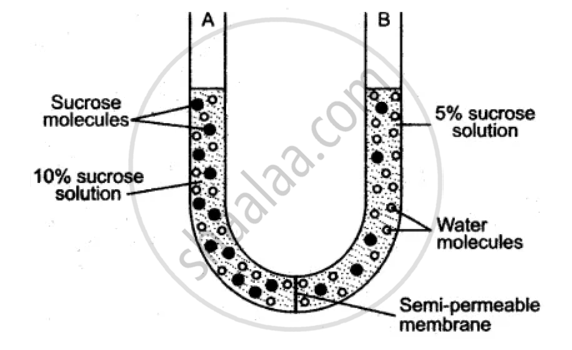
(i) What does the experiment demonstrate?
(ii) Define, the process demonstrated in the experiment.
(iii) What changes are observed after a few hours?
(iv) Give two examples of a semi-permeable membrane.
(v) Which limb of the U-tube contains a more concentrated sucrose solution, A or B?
(vi) Why is the membrane separating the two solutions labeled as semi-permeable membrane?
Advertisements
Solution
(i) The process of osmosis.
(ii) Osmosis is a special type of diffusion of solvent molecules through a semi-permeable membrane from a region of their higher concentration to the lower concentration region, but not vice versa.
(iii) The level of water in column A will rise along with the passage of time and will ultimately stop when the concentration of water molecules are equal on both sides of the membrane.
(iv) (a) Parchment paper, (b) Egg membrane.
(v) Solution A.
(vi) It permits the movement of only water molecules to pass through it.
RELATED QUESTIONS
A plant cell placed in a certain solution got plasmolysed. What was the kind of solution?
Osmosis and diffusion are the same except that osmosis there is:
Leaves of the sensitive plant wilt and droop down on a slight touch. What mechanism brings about this change?
Name the following:
The pressure with which the molecules of a substance diffuse.
Choose the correct answer:
Plasmolysis will occur when the cell is placed in a __________
What do you mean by transpiration pull ?
Give Reasons for the following.
Plants growing in fertilized soil are often found to wilt if the soil is not adequately watered. Why?
Given below is the figure of an experimental set up to demonstrate root pressure.
(i) Define root pressure.
(ii) What change would you observe in the water level after some time?
(iii) What role is being played by the root pressure in the given experiment?
(iv) Why the oil has been sprinkled on water?
Give Technical Term for the following.
A solution whose concentration is equal to the cell sap.
Multiple Choice Question:
Plasma membrane controls:
