Advertisements
Advertisements
Question
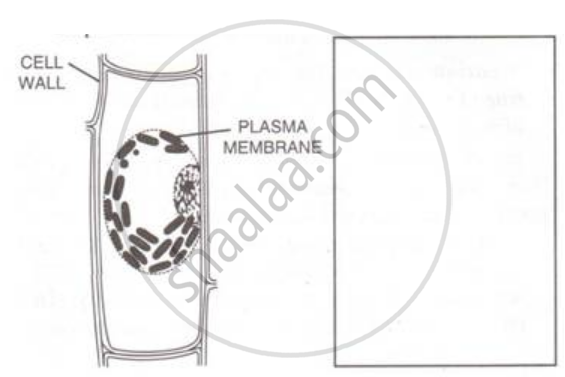
Give a diagrammatic representation of plasmolysis in a cell.
Advertisements
Solution

(a) A cell in normal turgid condition
(b) - (d) Successive stages in shrinkage of protoplasm from the cell well after being placed in a hypertonic solution. Diagrammatic representation of plasmolysis in a cell
RELATED QUESTIONS
Movement of molecules of a substance from the region of their higher concentration to the region of their lower concentration without the involvement a separating membrane, is called
The highest water potential (capacity to move out higher concentrated solution) is that of ______.
Give the equivalent terms for the following:
Pressure of the cell contents on the cell wall
Give reason for the following:
Potato cubes, when placed in water, become firm and increase in size.
Distinguish between the following:
Hypotonic and Hypertonic solutions
Name the following:
Condition of cell in which the cell contents are shrunken.
A leaf cell of a water plant was placed in a liquid other than pond water. After sometime, it assumed a shape as shown below:
Comment on the nature (tonicity) of the liquid surrounding the cell.
Give Reasons for the following.
Plants begin to die when the excess of soluble fertilizers are added to the soil?
Differentiate between the following
Endosmosis and Exosmosis
Explain the Term: Endosmosis
