Advertisements
Advertisements
Question
The below figure shows a root hair: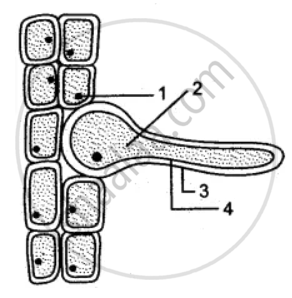
(i) Label the parts 1 to 4.
(ii) What is the role of part 4?
(iii) Why is the root hair one-celled?
(iv) What will happen to the root hair if some fertilizer is added to the soil near the root hair?
Advertisements
Solution
(i) 1. Nucleus
2. Vacuole
3. Cell wall
4. Cell membrane
(ii) Part 4 is the cell membrane. It is semi-permeable. It allows only water molecules to pass through it.
(iii) Because it is an extension of epiblema cell.
(iv) By the addition of fertilizer, root hair becomes flaccid, because water will move out of it as soil water becomes hypertonic.
RELATED QUESTIONS
Which one of the following is a characteristic NOT related with the suitability of the roots for absorbing water?
How is root hair adapted for the absorption of water from the soil?
Explain why:
Raisins swell up in water.
Choose the correct answer:
Which tissue makes passage for ascent of sap?
Choose the correct answer:
Absorption of water from soil takes place by __________
Choose the correct answer:
Exudation or bleeding is associated with ___________
Mention whether the following statement is true (T) or false (F) and give an explanation in support of your answer.
If the phloem of a twig is removed keeping the xylem intact, the leaves of a twig wilt.
Give Technical Term for the following.
Phenomenon of absorption of water by surface attraction.
Describe structure of root hair.
Water which is absorbed by roots is transported to aerial parts of the plant through ______
