Advertisements
Advertisements
Question
Process of ascent of sap in plants occurs by ______.
Options
cortex
xylem
phloem
cambium
Advertisements
Solution
Process of ascent of sap in plants occurs by xylem.
Explanation:
The ascent of sap is the upward movement of water and dissolved mineral nutrients from the roots to the leaves against gravity. This process occurs exclusively through the dead, hollow tube-like elements of the xylem tissue, driven by driving forces like transpiration pull and root pressure. In contrast, phloem is responsible for distributing manufactured organic food, while the cortex assists in lateral transport and the cambium manages growth.
APPEARS IN
RELATED QUESTIONS
The diagram of an given below demonstrates a particular process in plants. Study the same and answer the questions that follow:
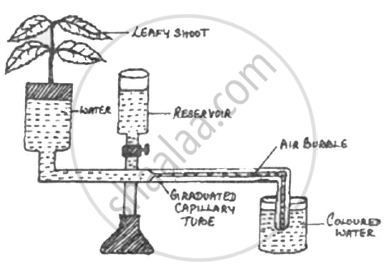
- Name the apparatus.
- Which phenomenon is demonstrated by this apparatus?
- Explain the phenomenon mentioned in (ii) above.
- State two limitations of using this apparatus.
- What is the importance of the air bubble in the experiment?
- Name the structures in a plant through which the above process takes place.
Which one of the following is a characteristic NOT related with the suitability of the roots for absorbing water?
What part is played by The cytoplasm in the uptake of water into the root hair?
The apparatus arranged alongside signifies an important process.
(i) Name the process.
(ii) Where does this process occur in plants?
(iii) What solution is placed inside the dialysis tubing?
(iv) What happens to the level of the solution in the capillary tube?

Three plants (a), (b) and (c) were placed in beakers containing coloured water. The water in each beaker was covered with a layer of oil. The leaves were removed from plant (b), while plant (c) was exposed to strong light.
(i) In which plant, (a), (b) or (c) would the water move up the fastest?
(ii) In which plant (a), (b) or (c), would the water move up slowly?
(iii) Why was the water covered with a layer of oil?
(iv) What is being investigated by this experiment?

Differentiate between the following
Permeable and Semi-permeable membrane.
Mention, if the following statement is True or False. If false rewrite the wrong statement in its correct form:
Xylem is the water-conducting tissue in plants.
Column ‘II’ is a list of items related to ideas in Column ‘I’. Match the term in Column ‘II’ with a suitable idea given in Column ‘I’.
| Column I | Column II |
| (i) Diffusion | (a) The exit or flow of water from the cell to the outer environment. |
| (ii) Xylem | (b) The shrinkage of protoplasm when the cell is kept in a hypertonic solution. |
| (iii) Root pressure | (c) The tissue through which water and mineral salts move upward in a plant. |
| (iv) Isotonic solution | (d) Two solutions which have equal osmotic pressure. |
| (v) Exosmosis | (e) The process by which the molecules of perfume spread in the room when the bottle is open. |
| (vi) Osmosis | (f) The process by which roots absorb water from the soil. |
| (vii) Plasmolysis | (g) The pressure by which water rises up to some feet in a lofty tree. |
| (viii) Hypotonic solution | (h) The concentration of the solution when lower than that of the cell sap. |
What is the composition of an outer layer of root hair?
Look at Figure. Draw another figure of the same set-up as would be observed after a few hours.

