Advertisements
Advertisements
Question
The diagram of an given below demonstrates a particular process in plants. Study the same and answer the questions that follow:
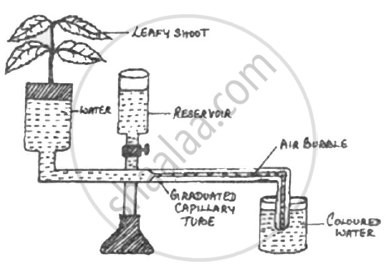
- Name the apparatus.
- Which phenomenon is demonstrated by this apparatus?
- Explain the phenomenon mentioned in (ii) above.
- State two limitations of using this apparatus.
- What is the importance of the air bubble in the experiment?
- Name the structures in a plant through which the above process takes place.
Advertisements
Solution
(i) The apparatus is called Ganong’s Potometer.
(ii) The phenomenon is called transpiration.
(iii) The evaporative loss of water in the form of water vapour from the aerial parts of plants is known as transpiration.
(iv) Two limitations are
- It is not easy to introduce the air bubble into the capillary.
- The twig may not remain fully alive for a long time.
(v) The air bubble helps measure the rate of transpiration.
(vi) Transpiration occurs through the leaves of plants.
APPEARS IN
RELATED QUESTIONS
Draw a magnified view of the root-hair, and describe, how it helps in the absorption of water from the soil.
Name the following:
The process by which water enters root hairs.
Give reason for the following:
If you uproot a plant from the soil, its leaves soon wilt.
The figure shows a diagrammatic representation of the movement of certain substances inside the stem of a certain plant. Write five sentences on whatever you can explain about the processes or the arrangement of structures indicated in the diagram.
Note: - Each sentence must include one or more of the following four words, and each word can be used several times. Xylem, phloem, roots, leaves.

The diagram below represents a layer of epidermal cells showing a fully grown root hair. Study the diagram and answer the questions that follow:

Draw a diagram of the above root hair cell as it would appear when a concentrated solution of fertilizers is added near it.
Given below is the diagram of a cell as seen under the microscope after having been placed in a solution:

(i) What is the technical term used for the state/condition of the cell given above?
(ii) Give the technical term for the solution in which the cell was placed.
(iii) Name the parts numbered 1 to 4.
(iv) Is the cell given above a plant cell or an animal cell ? Give two reasons in support of your answer as evident from the diagram.
(v) What would you do to bring this cell back to its original condition?
Column ‘II’ is a list of items related to ideas in Column ‘I’. Match the term in Column ‘II’ with a suitable idea given in Column ‘I’.
| Column I | Column II |
| (i) Diffusion | (a) The exit or flow of water from the cell to the outer environment. |
| (ii) Xylem | (b) The shrinkage of protoplasm when the cell is kept in a hypertonic solution. |
| (iii) Root pressure | (c) The tissue through which water and mineral salts move upward in a plant. |
| (iv) Isotonic solution | (d) Two solutions which have equal osmotic pressure. |
| (v) Exosmosis | (e) The process by which the molecules of perfume spread in the room when the bottle is open. |
| (vi) Osmosis | (f) The process by which roots absorb water from the soil. |
| (vii) Plasmolysis | (g) The pressure by which water rises up to some feet in a lofty tree. |
| (viii) Hypotonic solution | (h) The concentration of the solution when lower than that of the cell sap. |
Epiphytic plants like orchids absorb water vapours from air with the help of epiphytic roots having special tissue called ____________.
Which plant does tissue transport water and minerals from the roots to the leaf?
