Advertisements
Advertisements
प्रश्न
The diagram of an given below demonstrates a particular process in plants. Study the same and answer the questions that follow:
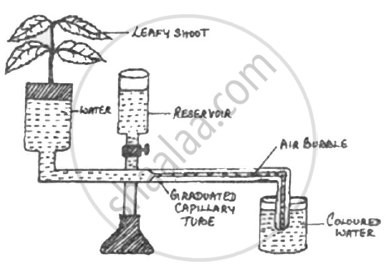
- Name the apparatus.
- Which phenomenon is demonstrated by this apparatus?
- Explain the phenomenon mentioned in (ii) above.
- State two limitations of using this apparatus.
- What is the importance of the air bubble in the experiment?
- Name the structures in a plant through which the above process takes place.
Advertisements
उत्तर
(i) The apparatus is called Ganong’s Potometer.
(ii) The phenomenon is called transpiration.
(iii) The evaporative loss of water in the form of water vapour from the aerial parts of plants is known as transpiration.
(iv) Two limitations are
- It is not easy to introduce the air bubble into the capillary.
- The twig may not remain fully alive for a long time.
(v) The air bubble helps measure the rate of transpiration.
(vi) Transpiration occurs through the leaves of plants.
APPEARS IN
संबंधित प्रश्न
Multiple Choice Question:
Put a tick mark (✓) against the correct alternative in the following statement:
The root-hairs are suited for absorbing water from the soil because:
What part is played by the following in the uptake of water into the root hair?
The cell wall
Choose the correct answer:
Which one is semi-permeable?
Choose the correct answer:
Meaning of ascent of sap is ____________
Mention whether the following statement is true (T) or false (F) and give an explanation in support of your answer.
Guttation in plants occurs maximum at midday.
Draw a neat and labelled diagram of the Root tip showing the root hair zone.
Root hairs are ______
Which part of the root helps in maximum absorption of water and minerals?
They are pipe-like, consisting of a group of specialised cells. They transport substances and form two-way traffic in plants. Which of the following terms qualify for the features mentioned above?
