Advertisements
Advertisements
प्रश्न
The diagram of an given below demonstrates a particular process in plants. Study the same and answer the questions that follow:
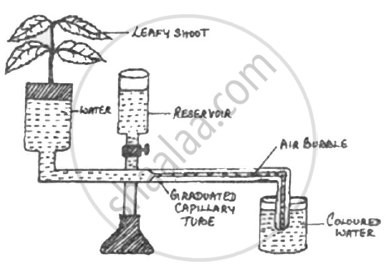
- Name the apparatus.
- Which phenomenon is demonstrated by this apparatus?
- Explain the phenomenon mentioned in (ii) above.
- State two limitations of using this apparatus.
- What is the importance of the air bubble in the experiment?
- Name the structures in a plant through which the above process takes place.
Advertisements
उत्तर
(i) The apparatus is called Ganong’s Potometer.
(ii) The phenomenon is called transpiration.
(iii) The evaporative loss of water in the form of water vapour from the aerial parts of plants is known as transpiration.
(iv) Two limitations are
- It is not easy to introduce the air bubble into the capillary.
- The twig may not remain fully alive for a long time.
(v) The air bubble helps measure the rate of transpiration.
(vi) Transpiration occurs through the leaves of plants.
APPEARS IN
संबंधित प्रश्न
The phenomenon of loss of water through a cut stem or injured part of plant is called ___________.
Mention whether the following statement is true or false. Correct the false statement by altering the last word only.
Xylem is the water conducting tissue in plants.
The figure shows a diagrammatic representation of the movement of certain substances inside the stem of a certain plant. Write five sentences on whatever you can explain about the processes or the arrangement of structures indicated in the diagram.
Note: - Each sentence must include one or more of the following four words, and each word can be used several times. Xylem, phloem, roots, leaves.

Mention whether the following statement is true (T) or false (F) and give explanation in support of your answer.
Dry seeds when submerged in water swell up due to endosmosis.
What is toxicity ?
Name the following:
Root hairs are the extension of which cells.
________ type of tissues are present in epiphytic roots.
Trace the pathway followed by water molecules from the time it enters a plant root to the time it escapes into the atmosphere from a leaf.
The unbranched root hair in plants is formed from ____________.
