Advertisements
Advertisements
प्रश्न
The diagram given below represents a plant cell after being placed in a strong sugar solution. Guidelines 1 to 5 indicate the following:
1. Strong sugar solution
2. Cell wall
3. Protoplasm
4. Large vacuole
5. Nucleus
Study the diagram and answer the questions that follow:
(i) What is the state of the cell shown in the diagram?
(ii) Name the structure which acts as a selectively permeable membrane.
(iii) If the cell had been placed in distilled water instead of strong sugar solution which feature would not have been present?
(iv) If the cell in the diagram possessed chloroplasts where would these be present?
(v) Name any one feature of this plant cell which is not present in animal cells.

Advertisements
उत्तर
(i) Plasmolysed cell
(ii) Plasma membrane
(iii) Large vacoule
(iv) The chloroplasts would be present in the shrunken protoplast.
(vi) Cell wall
APPEARS IN
संबंधित प्रश्न
Describe structure of root hair.
Plasma Membrane is ______.
What is the composition of an outer layer of root hair?
Part of the root that absorbs water from the soil is ______.
Trace the pathway followed by water molecules from the time it enters a plant root to the time it escapes into the atmosphere from a leaf.
Identify labels x, y, z in the given figure of root showing different regions.
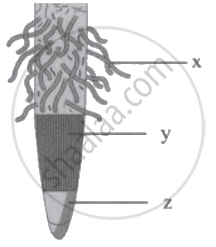
Which part of the root helps in maximum absorption of water and minerals?
Epiphytic plants like orchids absorb water vapours from air with the help of ______ having special tissue called velamen.
Which plant does tissue transport water and minerals from the roots to the leaf?
