Advertisements
Advertisements
प्रश्न
The diagram given below represents a plant cell after being placed in a strong sugar solution. Guidelines 1 to 5 indicate the following:
1. Strong sugar solution
2. Cell wall
3. Protoplasm
4. Large vacuole
5. Nucleus
Study the diagram and answer the questions that follow:
(i) What is the state of the cell shown in the diagram?
(ii) Name the structure which acts as a selectively permeable membrane.
(iii) If the cell had been placed in distilled water instead of strong sugar solution which feature would not have been present?
(iv) If the cell in the diagram possessed chloroplasts where would these be present?
(v) Name any one feature of this plant cell which is not present in animal cells.

Advertisements
उत्तर
(i) Plasmolysed cell
(ii) Plasma membrane
(iii) Large vacoule
(iv) The chloroplasts would be present in the shrunken protoplast.
(vi) Cell wall
APPEARS IN
संबंधित प्रश्न
Draw a magnified view of the root-hair, and describe, how it helps in the absorption of water from the soil.
How is root hair adapted for the absorption of water from the soil?
The diagram given below represents the result of an experiment conducted on two freshly taken shoots of a green herbaceous plant. The lower ends dip in the water.
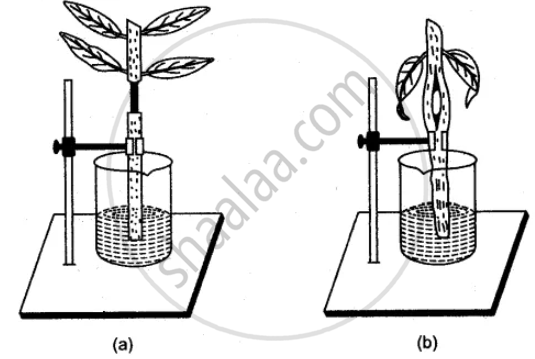
(i) What is the aim of the experiment?
(ii) Some parts of the stem in both the shoots have been removed. Name the conducting tissue in shoot A and in shoot B, that has been removed.
(iii) What are the results of this experiment?
Name the following:
The kind of cells that constitute the cortex of a root.
Name the following:
Root hairs are the extension of which cells.
Draw a neat and labelled diagram of the Root tip showing the root hair zone.
Identify the zone in wbkh root hair occurs.
Which of the following are the components of cell wall of root hair?
Root hair occurs in the zone of ____________.
Aquatic animals like fish excrete their wastes in gaseous form as ______.
