Advertisements
Advertisements
प्रश्न
Name the following:
The kind of cells that constitute the cortex of a root.
Advertisements
उत्तर
Parenchyma
संबंधित प्रश्न
Match the items in column I with those in column II
| Column I | Column II | ||
| (a) | Xylem | (i) | semi - permeable |
| (b) | Phloem | (ii) | permeable |
| (c) | Cell membrane | (iii) | downward flow of sap |
| (d) | Root pressure | (iv) | upward flow of water |
| (e) | Cell wall | (v) | guttation |
Choose the correct answer:
Swelling of wooden doors during rains is caused by ___________
Choose the correct answer:
Absorption of water from soil takes place by __________
Grapes shrink when immersed in a very strong sugar solution.” Explain.
The figure given below is a diagrammatic representation of a part of the cross-section of the root in the root hair zone. Study the same and then answer the questions that follow :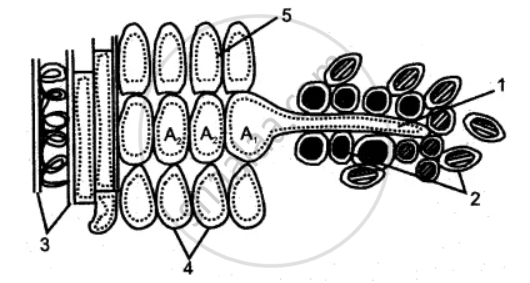
(i) Name the parts indicated by guidelines ‘1’ to ‘5’
(ii) Is the root hair cell unicellular or multi-cellular?
(iii) Draw a labeled diagram of the root hair cell as it would appear if some fertilizer is added to the soil close to it.
(iv) Name the process responsible for the entry of water molecules from the soil into A1 and then A2.
(v) What pressure is responsible for the movement of water in the direction indicated by arrows?
(vi) How is this pressure set up?
Give Technical Term for the following.
Phenomenon of absorption of water by surface attraction.
Plasma Membrane is ______.
Trace the pathway followed by water molecules from the time it enters a plant root to the time it escapes into the atmosphere from a leaf.
Draw a neat and proportionate diagram of root hair and label mitochondria, nucleus and vacuole.
What is peculiarity of epiphytic plants like orchids?
