Advertisements
Advertisements
प्रश्न
Match the items in column I with those in column II
| Column I | Column II | ||
| (a) | Xylem | (i) | semi - permeable |
| (b) | Phloem | (ii) | permeable |
| (c) | Cell membrane | (iii) | downward flow of sap |
| (d) | Root pressure | (iv) | upward flow of water |
| (e) | Cell wall | (v) | guttation |
Advertisements
उत्तर
| Column I | Column II | ||
| (a) | Xylem | (iv) | upward flow of water |
| (b) | Phloem | (iii) | downward flow of sap |
| (c) | Cell membrane | (i) | semi - permeable |
| (d) | Root pressure | (v) | guttation |
| (e) | Cell wall | (ii) | permeable |
APPEARS IN
संबंधित प्रश्न
The phenomenon of loss of water through a cut stem or injured part of plant is called ___________.
Name the following:
The process by which water enters root hairs.
Choose the correct answer:
Swelling of wooden doors during rains is caused by ___________
Study the experimental setup in the figure and then answer the question that follow.
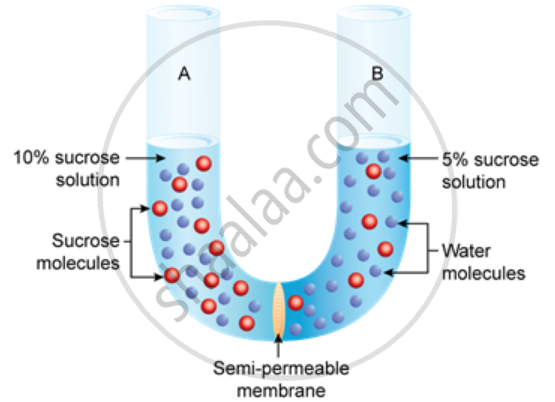
Explain the phenomenon mention in question 8.1 .
The below figure shows a root hair: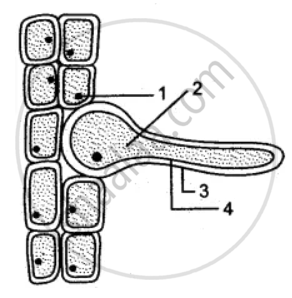
(i) Label the parts 1 to 4.
(ii) What is the role of part 4?
(iii) Why is the root hair one-celled?
(iv) What will happen to the root hair if some fertilizer is added to the soil near the root hair?
Give Technical Term for the following.
Phenomenon of absorption of water by surface attraction.
In the zone of absorption, epidermal cells form unicellular hair-like extensions called ________.
Plasma Membrane is ______.
Define: Root hair
Minerals cannot be passively absorbed by the roots.
