Advertisements
Advertisements
प्रश्न
Match the items in column I with those in column II
| Column I | Column II | ||
| (a) | Xylem | (i) | semi - permeable |
| (b) | Phloem | (ii) | permeable |
| (c) | Cell membrane | (iii) | downward flow of sap |
| (d) | Root pressure | (iv) | upward flow of water |
| (e) | Cell wall | (v) | guttation |
Advertisements
उत्तर
| Column I | Column II | ||
| (a) | Xylem | (iv) | upward flow of water |
| (b) | Phloem | (iii) | downward flow of sap |
| (c) | Cell membrane | (i) | semi - permeable |
| (d) | Root pressure | (v) | guttation |
| (e) | Cell wall | (ii) | permeable |
APPEARS IN
संबंधित प्रश्न
The apparatus arranged alongside signifies an important process.
(i) Name the process.
(ii) Where does this process occur in plants?
(iii) What solution is placed inside the dialysis tubing?
(iv) What happens to the level of the solution in the capillary tube?

The diagram given below represents a plant cell after being placed in a strong sugar solution. Guidelines 1 to 5 indicate the following:
1. Strong sugar solution
2. Cell wall
3. Protoplasm
4. Large vacuole
5. Nucleus
Study the diagram and answer the questions that follow:
(i) What is the state of the cell shown in the diagram?
(ii) Name the structure which acts as a selectively permeable membrane.
(iii) If the cell had been placed in distilled water instead of strong sugar solution which feature would not have been present?
(iv) If the cell in the diagram possessed chloroplasts where would these be present?
(v) Name any one feature of this plant cell which is not present in animal cells.

Mention whether the following statement is true (T) or false (F) and give explanation in support of your answer.
Dry seeds when submerged in water swell up due to endosmosis.
Grapes shrink when immersed in a very strong sugar solution.” Explain.
The below figure shows a root hair: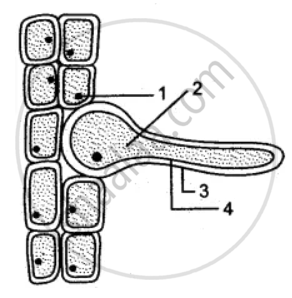
(i) Label the parts 1 to 4.
(ii) What is the role of part 4?
(iii) Why is the root hair one-celled?
(iv) What will happen to the root hair if some fertilizer is added to the soil near the root hair?
Mention, if the following statement is True or False. If false rewrite the wrong statement in its correct form:
Xylem is the water-conducting tissue in plants.
Water which is absorbed by roots is transported to aerial parts of the plant through ______
Root hairs are ______
