Advertisements
Advertisements
प्रश्न
Advertisements
उत्तर
The transport of water with dissolved minerals from the root to other aerial parts like stem and leaves, against gravity, is called translocation or ascent of sap.
संबंधित प्रश्न
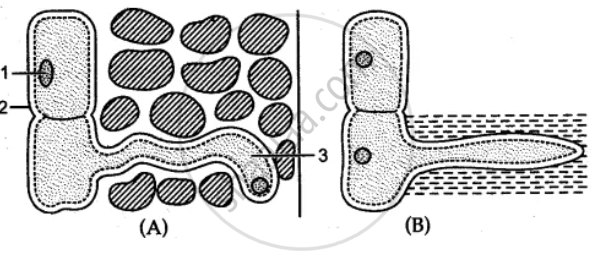
The figure given below is a diagrammatic representation of a part of the cross section of the root in the root hair zone. Study the same and then answer the questions that follow

(i) Name the parts indicated by the guidelines 1 to 4.
(ii) Which is the process that enables the passage of water from the soil into the root hair?
(iii) Name the pressure that is responsible for the movement of water in the direction indicated by the arrows. Define it.
(iv) Due to an excess of this pressure sometimes drops of water are found along the leaf margins of some plants especially in the early mornings. What is the phenomenon called?
(v) Draw a well labelled diagram of the root hair cell as it would appear if an excess of fertiliser is added to the soil close to it.
Match the items in column I with those in column II
| Column I | Column II | ||
| (a) | Xylem | (i) | semi - permeable |
| (b) | Phloem | (ii) | permeable |
| (c) | Cell membrane | (iii) | downward flow of sap |
| (d) | Root pressure | (iv) | upward flow of water |
| (e) | Cell wall | (v) | guttation |
What part is played by the following in the uptake of water into the root hair?
The cell wall
Mention whether the following statement is true (T) or false (F) and give an explanation in support of your answer.
If the phloem of a twig is removed keeping the xylem intact, the leaves of a twig wilt.
Root hairs become flaccid, when fertilizers are added to the moist soil around it. Explain.
Give Technical Term for the following.
Tissue which transports manufactured food from leaves to other parts of the plant.
Give Technical Term for the following.
The tissue responsible for the ascent of sap in plants.
Column ‘II’ is a list of items related to ideas in Column ‘I’. Match the term in Column ‘II’ with a suitable idea given in Column ‘I’.
| Column I | Column II |
| (i) Diffusion | (a) The exit or flow of water from the cell to the outer environment. |
| (ii) Xylem | (b) The shrinkage of protoplasm when the cell is kept in a hypertonic solution. |
| (iii) Root pressure | (c) The tissue through which water and mineral salts move upward in a plant. |
| (iv) Isotonic solution | (d) Two solutions which have equal osmotic pressure. |
| (v) Exosmosis | (e) The process by which the molecules of perfume spread in the room when the bottle is open. |
| (vi) Osmosis | (f) The process by which roots absorb water from the soil. |
| (vii) Plasmolysis | (g) The pressure by which water rises up to some feet in a lofty tree. |
| (viii) Hypotonic solution | (h) The concentration of the solution when lower than that of the cell sap. |
____________ regions are present in a typical root.
____________plants like orchids absorb water vapours from air with the help of epiphytic roots having special tissue called velamen.