Advertisements
Advertisements
प्रश्न
The figure given below is a diagrammatic representation of a part of the cross section of the root in the root hair zone. Study the same and then answer the questions that follow

(i) Name the parts indicated by the guidelines 1 to 4.
(ii) Which is the process that enables the passage of water from the soil into the root hair?
(iii) Name the pressure that is responsible for the movement of water in the direction indicated by the arrows. Define it.
(iv) Due to an excess of this pressure sometimes drops of water are found along the leaf margins of some plants especially in the early mornings. What is the phenomenon called?
(v) Draw a well labelled diagram of the root hair cell as it would appear if an excess of fertiliser is added to the soil close to it.
Advertisements
उत्तर
(i) 1: Root hair, 2: Soil particle, 3: Xylem vessel, 4: Vacuoles
(ii) Osmosis is the process which enables the passage of water from the soil into root hair.
(iii) Root pressure is responsible for the movement of water. It is the pressure developed in the roots because of the inflow of water.
(iv) Guttation
(v) 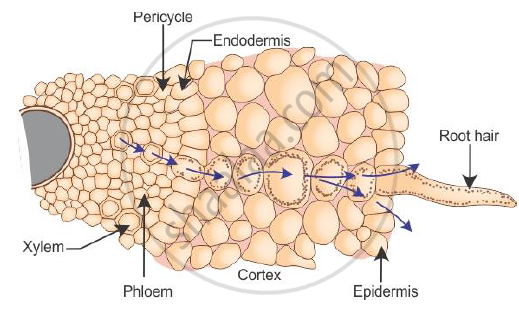
APPEARS IN
संबंधित प्रश्न
The diagram below represents a layer of epidermal cells showing a fully grown root hair. Study the diagram and answer the questions that follow:

The root hair cell is in a turgid state. Name and explain the process that caused this state.
Study the experimental setup in the figure and then answer the question that follow.
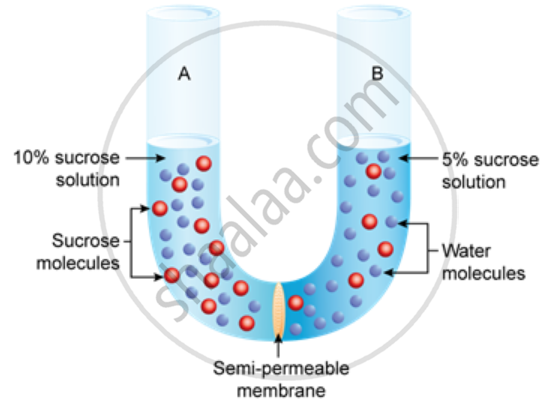
What will you observe in the setup after about half an hour? Give reasons for your answer.
What is toxicity ?
Give Technical Term for the following.
The tissue responsible for the ascent of sap in plants.
Mention, if the following statement is True or False. If false rewrite the wrong statement in its correct form:
Xylem is the water-conducting tissue in plants.
Multiple Choice Question:
In soil, water available for absorption by root is ______.
From which type of cells, root hair is originated
Minerals cannot be passively absorbed by the roots.
Which of the following are the components of cell wall of root hair?
The unbranched root hair in plants is formed from ____________.
