Advertisements
Advertisements
Question
The figure given below is a diagrammatic representation of a part of the cross section of the root in the root hair zone. Study the same and then answer the questions that follow

(i) Name the parts indicated by the guidelines 1 to 4.
(ii) Which is the process that enables the passage of water from the soil into the root hair?
(iii) Name the pressure that is responsible for the movement of water in the direction indicated by the arrows. Define it.
(iv) Due to an excess of this pressure sometimes drops of water are found along the leaf margins of some plants especially in the early mornings. What is the phenomenon called?
(v) Draw a well labelled diagram of the root hair cell as it would appear if an excess of fertiliser is added to the soil close to it.
Advertisements
Solution
(i) 1: Root hair, 2: Soil particle, 3: Xylem vessel, 4: Vacuoles
(ii) Osmosis is the process which enables the passage of water from the soil into root hair.
(iii) Root pressure is responsible for the movement of water. It is the pressure developed in the roots because of the inflow of water.
(iv) Guttation
(v) 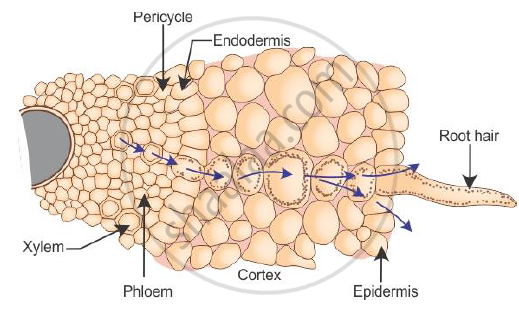
APPEARS IN
RELATED QUESTIONS
Give reason for the following:
If you uproot a plant from the soil, its leaves soon wilt.
What part is played by The cytoplasm in the uptake of water into the root hair?
Process of ascent of sap in plants occurs by ______.
Choose the correct answer:
Wilting of plants occurs when ____________
Mention whether the following statement is true (T) or false (F) and give explanation in support of your answer.
Dry seeds when submerged in water swell up due to endosmosis.
Draw a diagram of the root hair cell as it would appear when a concentrated solution of fertilizers is added near it.
Fill in the Blank
Leaves get wilted if _________ is removed from the plant.
Multiple Choice Question:
Water will be absorbed by the root hairs when:
Look at Figure. Draw another figure of the same set-up as would be observed after a few hours.

Explain about the factors that affect water absorption.
