Advertisements
Advertisements
Question
Advertisements
Solution
The transport of water with dissolved minerals from the root to other aerial parts like stem and leaves, against gravity, is called translocation or ascent of sap.
RELATED QUESTIONS
Study the diagram given below and answer the questions that follow:

- Name the process being studied in the above experiment.
- Explain the process mentioned in (a) above
- Why is oil placed over water?
- What do we observe with regard to the level of water when this set-up is placed in (1) bright sunlight, (2) humid conditions and (3) windy days?
- Mention any three adaptations found in plants to foster the process mentioned in (a) above
Three plants (a), (b) and (c) were placed in beakers containing coloured water. The water in each beaker was covered with a layer of oil. The leaves were removed from plant (b), while plant (c) was exposed to strong light.
(i) In which plant, (a), (b) or (c) would the water move up the fastest?
(ii) In which plant (a), (b) or (c), would the water move up slowly?
(iii) Why was the water covered with a layer of oil?
(iv) What is being investigated by this experiment?

Mention whether the following statement is true (T) or false (F) and give an explanation in support of your answer.
Guttation in plants occurs maximum at midday.
The diagram below represents a layer of epidermal cells showing a fully grown root hair. Study the diagram and answer the questions that follow:

The root hair cell is in a turgid state. Name and explain the process that caused this state.
A thin strip of epidermal cells from the fleshy scales of an onion bulb was examined in a drop of water, under a microscope. All the epidermal cells looked alike and the figure alongside represents one of them. The thin strip was then transferred to a drop of strong sugar solution and re-examined under the microscope after about five minutes.

(i) Make a sketch of one of the epidermal cells, as it might appear after immersion in a strong sugar solution. Label any two parts which have undergone a change.
(ii) Give the scientific term for the change shown in Q.(i) above.
(iii) What would you do to bring this cell back to its original condition?
(iv) Give the scientific term used for the recovery of the cell as a result of the step taken in Q.(iii) above.
Name the following:
The kind of cells that constitute the cortex of a root.
Give Technical Term for the following.
Tissue which transports manufactured food from leaves to other parts of the plant.
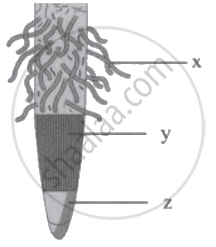
Identify labels x, y, z in the given figure of root showing different regions.
Which plant does tissue transport water and minerals from the roots to the leaf?
They are pipe-like, consisting of a group of specialised cells. They transport substances and form two-way traffic in plants. Which of the following terms qualify for the features mentioned above?
