Advertisements
Advertisements
Question
What is toxicity ?
Advertisements
Solution
It refers to the kind of external osmotic environment of a cell or it refers to the type of solution outside the cell.
RELATED QUESTIONS
Multiple Choice Question:
Put a tick mark (✓) against the correct alternative in the following statement:
The root-hairs are suited for absorbing water from the soil because:
Process of ascent of sap in plants occurs by ______.
Study the experimental setup in the figure and then answer the question that follow.
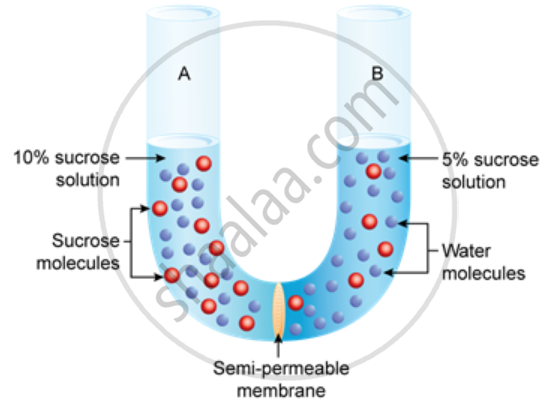
What is meant by 'semipermeable membrane'?
Given below is the diagram of a cell as seen under the microscope after having been placed in a solution:

(i) What is the technical term used for the state/condition of the cell given above?
(ii) Give the technical term for the solution in which the cell was placed.
(iii) Name the parts numbered 1 to 4.
(iv) Is the cell given above a plant cell or an animal cell ? Give two reasons in support of your answer as evident from the diagram.
(v) What would you do to bring this cell back to its original condition?
Draw a cross-section of root showing association of soil particles with root hairs.
Name the following:
Name the process by which intact plants lose water in the form of droplets.
Mention, if the following statement is True or False. If false rewrite the wrong statement in its correct form:
Xylem is the water-conducting tissue in plants.
Draw a neat and labelled diagram of Root hair.
Which of the following are the components of cell wall of root hair?
