Advertisements
Advertisements
Question
Choose the correct answer:
Exudation or bleeding is associated with ___________
Options
capillarity
imbibition
hydrostatic pressure in the root
pulsation in the innermost layer of cortex
Advertisements
Solution
Exudation or bleeding is associated with hydrostatic pressure in the root
RELATED QUESTIONS
The process by which root hairs absorb water from the soil.
The phenomenon of loss of water through a cut stem or injured part of plant is called ___________.
Choose the correct answer:
Which tissue makes passage for ascent of sap?
The diagram given below represents the result of an experiment conducted on two freshly taken shoots of a green herbaceous plant. The lower ends dip in the water.
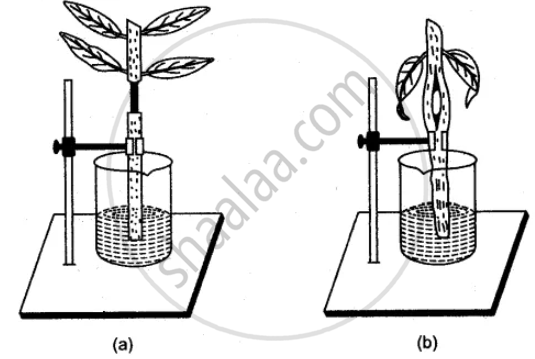
(i) What is the aim of the experiment?
(ii) Some parts of the stem in both the shoots have been removed. Name the conducting tissue in shoot A and in shoot B, that has been removed.
(iii) What are the results of this experiment?
Column ‘II’ is a list of items related to ideas in Column ‘I’. Match the term in Column ‘II’ with a suitable idea given in Column ‘I’.
| Column I | Column II |
| (i) Diffusion | (a) The exit or flow of water from the cell to the outer environment. |
| (ii) Xylem | (b) The shrinkage of protoplasm when the cell is kept in a hypertonic solution. |
| (iii) Root pressure | (c) The tissue through which water and mineral salts move upward in a plant. |
| (iv) Isotonic solution | (d) Two solutions which have equal osmotic pressure. |
| (v) Exosmosis | (e) The process by which the molecules of perfume spread in the room when the bottle is open. |
| (vi) Osmosis | (f) The process by which roots absorb water from the soil. |
| (vii) Plasmolysis | (g) The pressure by which water rises up to some feet in a lofty tree. |
| (viii) Hypotonic solution | (h) The concentration of the solution when lower than that of the cell sap. |
Multiple Choice Question:
Water will be absorbed by the root hairs when:
Epiphytic plants like orchids absorb water vapours from air with the help of ______ having special tissue called velamen.
Which plant does tissue transport water and minerals from the roots to the leaf?
Explain about the factors that affect water absorption.
