Advertisements
Advertisements
Question
Choose the correct answer:
Which tissue makes passage for ascent of sap?
Options
Cortex
Endodermis
Phloem
Xylem
Advertisements
Solution
Xylem
RELATED QUESTIONS
Correct the following statement by changing the underlined word.
Xylem transports starch from the leaves to all parts of the plant body.
The diagram given below represents the results of an experiment conducted on two freshly taken leafy shoots of a herbaceous plant. The lower ends of the shoots dip in ordinary water.
(i) What is the aim of the experiment?
(ii) Some parts of the stem in both the shoots have been removed. Name the conducting tissue in shoot (a) and in shoot (b) that has been removed.
(iii) What are the results of this experiment?

Choose the correct answer:
In ascent of sap water reaches upwards ____________
Study the experimental setup in the figure and then answer the question that follow.
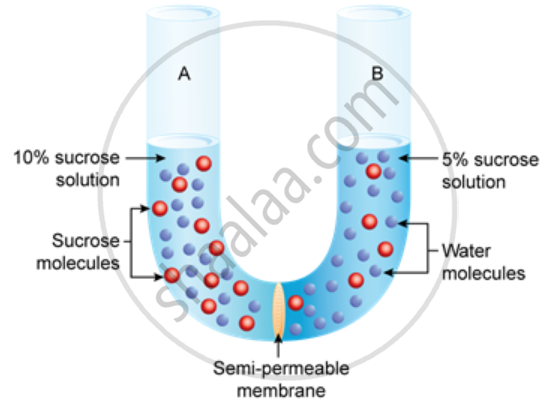
What is meant by 'semipermeable membrane'?
Draw a diagram of the root hair cell as it would appear when a concentrated solution of fertilizers is added near it.
The diagram given below represents the result of an experiment conducted on two freshly taken shoots of a green herbaceous plant. The lower ends dip in the water.
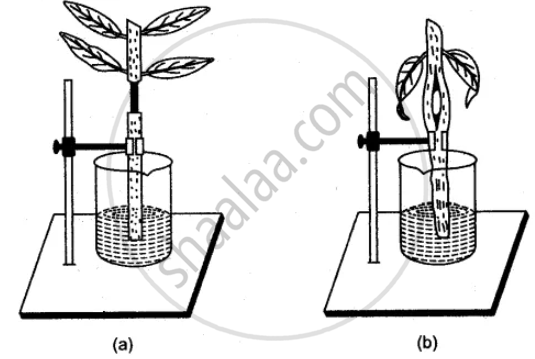
(i) What is the aim of the experiment?
(ii) Some parts of the stem in both the shoots have been removed. Name the conducting tissue in shoot A and in shoot B, that has been removed.
(iii) What are the results of this experiment?
Describe structure of root hair.
Which part of the root helps in the maximum absorption of water and minerals?
The unbranched root hair in plants is formed from ____________.
Water in the root enters due to ______.
