Advertisements
Advertisements
Question
The diagram given below represents the result of an experiment conducted on two freshly taken shoots of a green herbaceous plant. The lower ends dip in the water.
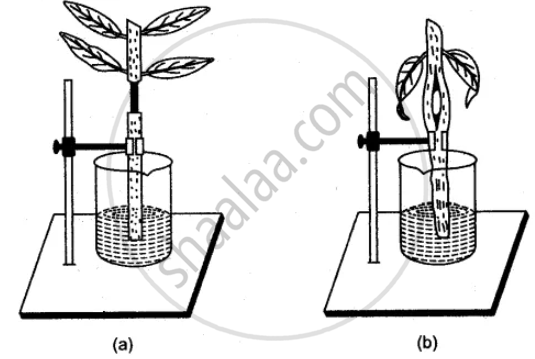
(i) What is the aim of the experiment?
(ii) Some parts of the stem in both the shoots have been removed. Name the conducting tissue in shoot A and in shoot B, that has been removed.
(iii) What are the results of this experiment?
Advertisements
Solution
(i) To demonstrate the role of xylem and phloem in flowering plants.
(ii) In the shoot, A phloem tissue has been removed. In shoot B central xylem tissue has been removed.
(iii) Plant A gets water and minerals and synthesizes its food and remains healthy. Plant B due to lack of xylem does not get its supply of water and minerals. The leaves are seen drooping and will dry.
RELATED QUESTIONS
Name the following:
The process by which water enters root hairs.
Explain the mechanism of closing and opening of the stomata.
Give Technical Term for the following.
Phenomenon of absorption of water by surface attraction.
Multiple Choice Question:
Water will be absorbed by the root hairs when:
A thin strip of epidermal cells of a leaf was observed in a drop of water. They all looked turgid and normal.
(a) Draw a diagram of such a cell.
(b) Draw a diagram of a cell if this strip is transferred to a strong concentrated solution of sugar. What is term used for the effect on the cells ?
Root hairs are ______
Minerals cannot be passively absorbed by the roots.
Which part of the root helps in maximum absorption of water and minerals?
Give other name of epidermal cells in roots of plants.
Name the following:
Unicellular outgrowths from the epidermis of roots.
