Advertisements
Advertisements
प्रश्न
The diagram given below represents the result of an experiment conducted on two freshly taken shoots of a green herbaceous plant. The lower ends dip in the water.
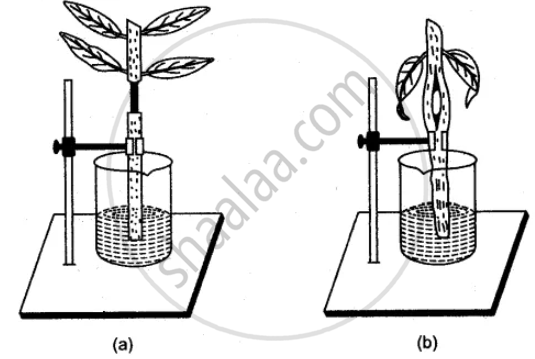
(i) What is the aim of the experiment?
(ii) Some parts of the stem in both the shoots have been removed. Name the conducting tissue in shoot A and in shoot B, that has been removed.
(iii) What are the results of this experiment?
Advertisements
उत्तर
(i) To demonstrate the role of xylem and phloem in flowering plants.
(ii) In the shoot, A phloem tissue has been removed. In shoot B central xylem tissue has been removed.
(iii) Plant A gets water and minerals and synthesizes its food and remains healthy. Plant B due to lack of xylem does not get its supply of water and minerals. The leaves are seen drooping and will dry.
संबंधित प्रश्न
Name the following:
Water is absorbed from the soil by which part.
Name the following:
The solution outside the cell having lower solute concentration than the fluids.
Name the following:
Name the process by which intact plants lose water in the form of droplets.
Most plant cells and tissues constitutes _____ % water.
What is the composition of inner layer of root hair?
What would happen to the leaves of a plant that transpires more water than its absorption in the roots?
Epiphytic plants like orchids absorb water vapours from air with the help of ______ having special tissue called velamen.
Which plant does tissue transport water and minerals from the roots to the leaf?
Paheli uprooted a rose plant from the soil. Most of the root tips, with root hairs, got left behind in the soil. She planted it in a pot with new soil and watered it regularly. Will the plant grow or die? Give reason for your answer.
