Advertisements
Advertisements
Question
Given below is the diagram of a cell as seen under the microscope after having been placed in a solution:

(i) What is the technical term used for the state/condition of the cell given above?
(ii) Give the technical term for the solution in which the cell was placed.
(iii) Name the parts numbered 1 to 4.
(iv) Is the cell given above a plant cell or an animal cell ? Give two reasons in support of your answer as evident from the diagram.
(v) What would you do to bring this cell back to its original condition?
Advertisements
Solution
(i) Plasmolysis
(ii) Hypertonic solution
(iii) (1) Nucleus, (2) Sugar drops, (3) Small vacuole, (4) Large vacuole.
(iv) Plant cell (1) Presence of cell wall, (2) Presence of large vacuole.
(v) It has to be placed in a hypotonic solution.
RELATED QUESTIONS
Name the following:
The process by which water enters root hairs.
The figure shows a diagrammatic representation of the movement of certain substances inside the stem of a certain plant. Write five sentences on whatever you can explain about the processes or the arrangement of structures indicated in the diagram.
Note: - Each sentence must include one or more of the following four words, and each word can be used several times. Xylem, phloem, roots, leaves.

Choose the correct answer:
An example of a selective permeable membrane is __________
Study the experimental setup in the figure and then answer the question that follow.
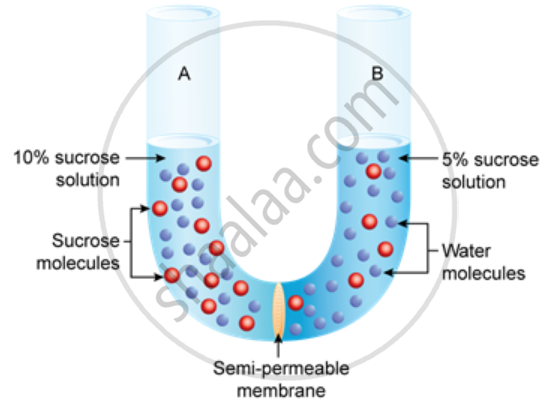
What is meant by 'semipermeable membrane'?
A few RBC’s were kept in three test tubes containing isotonic, hypotonic and hypertonic solutions. What will be the expected observations after a few hours? Explain.
Draw a cross-section of root showing association of soil particles with root hairs.
Draw a diagram of the root hair cell as it would appear when a concentrated solution of fertilizers is added near it.
Multiple Choice Question:
Process of endosmosis stops:
Multiple Choice Question:
The most widely accepted theory for ascent of sap is ______.
