Advertisements
Advertisements
प्रश्न
Given below is the diagram of a cell as seen under the microscope after having been placed in a solution:

(i) What is the technical term used for the state/condition of the cell given above?
(ii) Give the technical term for the solution in which the cell was placed.
(iii) Name the parts numbered 1 to 4.
(iv) Is the cell given above a plant cell or an animal cell ? Give two reasons in support of your answer as evident from the diagram.
(v) What would you do to bring this cell back to its original condition?
Advertisements
उत्तर
(i) Plasmolysis
(ii) Hypertonic solution
(iii) (1) Nucleus, (2) Sugar drops, (3) Small vacuole, (4) Large vacuole.
(iv) Plant cell (1) Presence of cell wall, (2) Presence of large vacuole.
(v) It has to be placed in a hypotonic solution.
संबंधित प्रश्न
What are root hair? Mention the function performed by the root hair.
Name the following:
Tissue concerned with upward conduction of water.
Three plants (a), (b) and (c) were placed in beakers containing coloured water. The water in each beaker was covered with a layer of oil. The leaves were removed from plant (b), while plant (c) was exposed to strong light.
(i) In which plant, (a), (b) or (c) would the water move up the fastest?
(ii) In which plant (a), (b) or (c), would the water move up slowly?
(iii) Why was the water covered with a layer of oil?
(iv) What is being investigated by this experiment?

Choose the correct answer:
Absorption of water from soil takes place by __________
Mention whether the following statement is true (T) or false (F) and give explanation in support of your answer.
Dry seeds when submerged in water swell up due to endosmosis.
Study the experimental setup in the figure and then answer the question that follow.
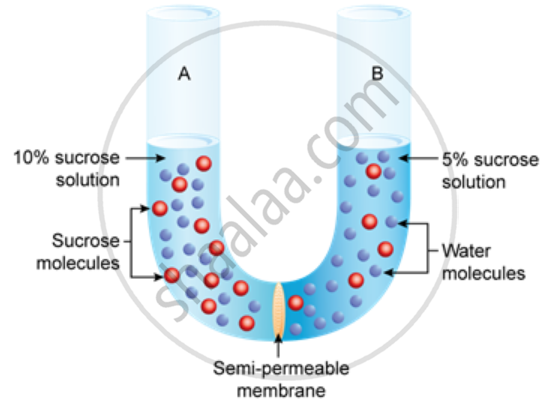
What will you observe in the setup after about half an hour? Give reasons for your answer.
How is root hair structurally adapted for absorption of water from the soil?
________ type of tissues are present in epiphytic roots.
Draw a neat and labelled diagram of the Root tip showing the root hair zone.
Which of the following are the components of cell wall of root hair?
