Advertisements
Advertisements
प्रश्न
The alongside diagram A shows a root hair growing through the soil particles. Diagram B is the root hair of an aquatic plant.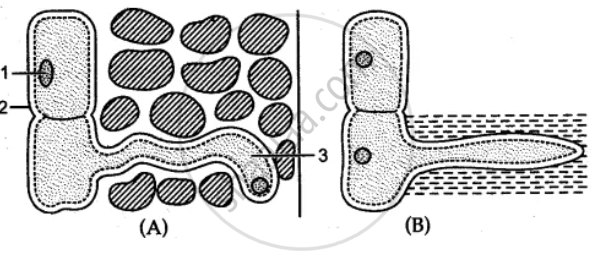
(i) Name the parts 1,2,3.
(ii) Name two substances which enter the root hair. What are their uses?
(iii) By what process do these substances enter the root hair?
(iv) Account for the different shapes of root hairs in the two diagrams.
Advertisements
उत्तर
(i) 1-Nucleus. 2-Cell wall. 3-Cytoplasm of the root hair cell.
(ii) 1. Water: Carries minerals to the plant.
2. Minerals: They are needed for healthy plant growth.
(iii) Osmosis.
(iv) In the Fig. A, the root hair has to pass through the soil particles, and as such, they are not straight. In the Fig. B, the root hair has no obstruction in water, and as such it grows straight.
संबंधित प्रश्न
Correct the following statement by changing the underlined word.
Xylem transports starch from the leaves to all parts of the plant body.
What are root hair? Mention the function performed by the root hair.
Differentiate between the following:
Guttation and bleeding
What is toxicity ?
Give Technical Term for the following.
Tissue which transports manufactured food from leaves to other parts of the plant.
Name the following:
Name the process by which intact plants lose water in the form of droplets.
A thin strip of epidermal cells of a leaf was observed in a drop of water. They all looked turgid and normal.
(a) Draw a diagram of such a cell.
(b) Draw a diagram of a cell if this strip is transferred to a strong concentrated solution of sugar. What is term used for the effect on the cells ?
Write a note on the morphological structure of the root.
Draw a neat and proportionate diagram of root hair and label mitochondria, nucleus and vacuole.
Give other name of epidermal cells in roots of plants.
