Advertisements
Advertisements
Question
The alongside diagram A shows a root hair growing through the soil particles. Diagram B is the root hair of an aquatic plant.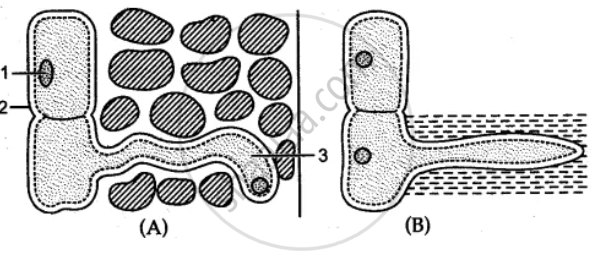
(i) Name the parts 1,2,3.
(ii) Name two substances which enter the root hair. What are their uses?
(iii) By what process do these substances enter the root hair?
(iv) Account for the different shapes of root hairs in the two diagrams.
Advertisements
Solution
(i) 1-Nucleus. 2-Cell wall. 3-Cytoplasm of the root hair cell.
(ii) 1. Water: Carries minerals to the plant.
2. Minerals: They are needed for healthy plant growth.
(iii) Osmosis.
(iv) In the Fig. A, the root hair has to pass through the soil particles, and as such, they are not straight. In the Fig. B, the root hair has no obstruction in water, and as such it grows straight.
RELATED QUESTIONS
The process by which root hairs absorb water from the soil.
The diagram given below represents a plant cell after being placed in a strong sugar solution. Guidelines 1 to 5 indicate the following:
1. Strong sugar solution
2. Cell wall
3. Protoplasm
4. Large vacuole
5. Nucleus
Study the diagram and answer the questions that follow:
(i) What is the state of the cell shown in the diagram?
(ii) Name the structure which acts as a selectively permeable membrane.
(iii) If the cell had been placed in distilled water instead of strong sugar solution which feature would not have been present?
(iv) If the cell in the diagram possessed chloroplasts where would these be present?
(v) Name any one feature of this plant cell which is not present in animal cells.

Process of ascent of sap in plants occurs by ______.
Choose the correct answer:
Wilting of plants occurs when ____________
Study the experimental setup in the figure and then answer the question that follow.
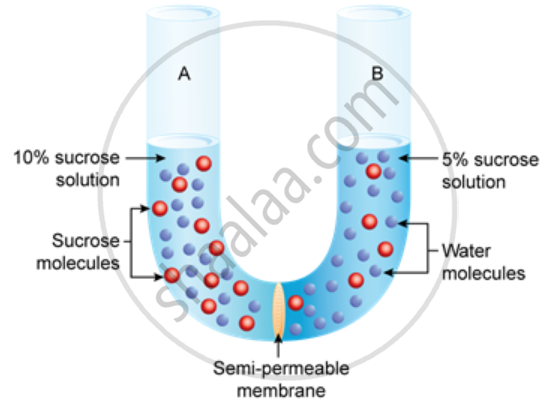
What is meant by 'semipermeable membrane'?
Multiple Choice Question:
The most widely accepted theory for ascent of sap is ______.
________ type of tissues are present in epiphytic roots.
Plasma Membrane is ______.
Root hairs are ______
Explain about the factors that affect water absorption.
