Advertisements
Advertisements
प्रश्न
The alongside diagram A shows a root hair growing through the soil particles. Diagram B is the root hair of an aquatic plant.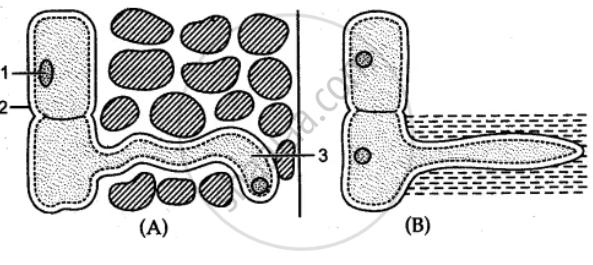
(i) Name the parts 1,2,3.
(ii) Name two substances which enter the root hair. What are their uses?
(iii) By what process do these substances enter the root hair?
(iv) Account for the different shapes of root hairs in the two diagrams.
Advertisements
उत्तर
(i) 1-Nucleus. 2-Cell wall. 3-Cytoplasm of the root hair cell.
(ii) 1. Water: Carries minerals to the plant.
2. Minerals: They are needed for healthy plant growth.
(iii) Osmosis.
(iv) In the Fig. A, the root hair has to pass through the soil particles, and as such, they are not straight. In the Fig. B, the root hair has no obstruction in water, and as such it grows straight.
संबंधित प्रश्न
the exact location of the Lenticels
Concentration of mineral nutrient elements is higher inside the root hairs than in the surrounding soil. How do roots take them in from the soil?
What part is played by the following in the uptake of water into the root hair?
The cell wall
Choose the correct answer:
Absorption of water from soil takes place by __________
Study the experimental setup in the figure and then answer the question that follow.
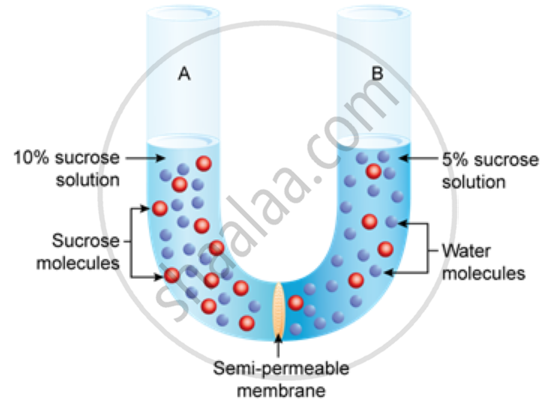
What is meant by 'semipermeable membrane'?
Given below is the diagram of a cell as seen under the microscope after having been placed in a solution:

(i) What is the technical term used for the state/condition of the cell given above?
(ii) Give the technical term for the solution in which the cell was placed.
(iii) Name the parts numbered 1 to 4.
(iv) Is the cell given above a plant cell or an animal cell ? Give two reasons in support of your answer as evident from the diagram.
(v) What would you do to bring this cell back to its original condition?
Identify the zone in wbkh root hair occurs.
____________plants like orchids absorb water vapours from air with the help of epiphytic roots having special tissue called velamen.
Epiphytic plants like ____________ absorb water vapours from air with the help of epiphytic roots having special tissue called velamen.
