Advertisements
Advertisements
प्रश्न
The diagram below represents a layer of epidermal cells showing a fully grown root hair. Study the diagram and answer the questions that follow:

Mention one distinct difference between the parts labelled A and B.
Advertisements
उत्तर
|
Cell wall |
Cell membrane |
|
The cell wall of a root hair is freely permeable and allows both salt and water to pass through. |
The cell membrane of a root hair is semi-permeable and does not allow large dissolved salt molecules to pass through. |
संबंधित प्रश्न
The diagram of an given below demonstrates a particular process in plants. Study the same and answer the questions that follow :
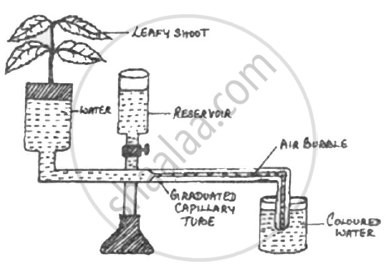
(i) Name the apparatus.
(ii) Which phenomenon is demonstrated by this apparatus?
(iii) Explain the phenomenon mentioned in (ii) above.
(iv) State two limitations of using this apparatus.
(v) What is the importance of the air bubble in the experiment?
(vi) Name the structures in a plant through which the above process takes place.
Which one of the following is a characteristic NOT related with the suitability of the roots for absorbing water?
Give reason for the following:
If you uproot a plant from the soil, its leaves soon wilt.
How is root hair adapted for the absorption of water from the soil?
Draw a cross-section of root showing association of soil particles with root hairs.
The figure given below is a diagrammatic representation of a part of the cross-section of the root in the root hair zone. Study the same and then answer the questions that follow :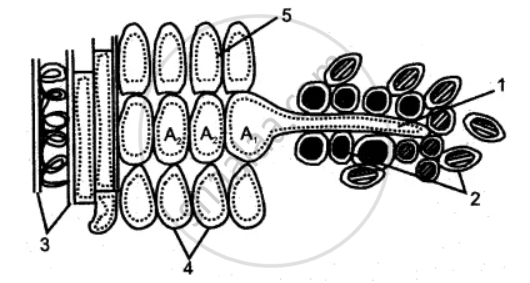
(i) Name the parts indicated by guidelines ‘1’ to ‘5’
(ii) Is the root hair cell unicellular or multi-cellular?
(iii) Draw a labeled diagram of the root hair cell as it would appear if some fertilizer is added to the soil close to it.
(iv) Name the process responsible for the entry of water molecules from the soil into A1 and then A2.
(v) What pressure is responsible for the movement of water in the direction indicated by arrows?
(vi) How is this pressure set up?
Name the following:
Water is absorbed from the soil by which part.
What is the composition of an outer layer of root hair?
Aquatic animals like fish excrete their wastes in gaseous form as ______.
Draw a neat and proportionate diagram of root hair and label mitochondria, nucleus and vacuole.
