Advertisements
Advertisements
प्रश्न
The diagram of an given below demonstrates a particular process in plants. Study the same and answer the questions that follow :
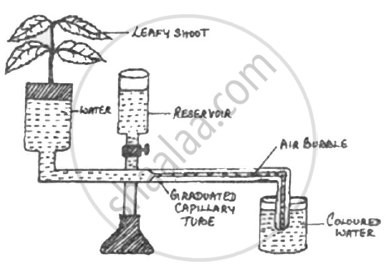
(i) Name the apparatus.
(ii) Which phenomenon is demonstrated by this apparatus?
(iii) Explain the phenomenon mentioned in (ii) above.
(iv) State two limitations of using this apparatus.
(v) What is the importance of the air bubble in the experiment?
(vi) Name the structures in a plant through which the above process takes place.
Advertisements
उत्तर
(i) The apparatus is called Ganong’s Potometer.
(ii) The phenomenon is called transpiration.
(iii) The evaporative loss of water in the form of water vapour from the aerial parts of plants is known as transpiration.
(iv) Two limitations are
- It is not easy to introduce the air bubble into the capillary.
- The twig may not remain fully alive for a long time.
(v) The air bubble helps measure the rate of transpiration.
(vi) Transpiration occurs through roots.
APPEARS IN
संबंधित प्रश्न
Correct the following statement by changing the underlined word.
Xylem transports starch from the leaves to all parts of the plant body.
How is root hair adapted for the absorption of water from the soil?
What would happen to the root hair of a potted plant if the soil was watered with an extremely concentrated solution of sodium chloride?
Mention whether the following statement is true (T) or false (F) and give an explanation in support of your answer.
Guttation in plants occurs maximum at midday.
Give Technical Term for the following.
Tissue which transports manufactured food from leaves to other parts of the plant.
Epiphytic plants like orchids absorb water vapours from air with the help of epiphytic roots having special tissue called ____________.
____________plants like orchids absorb water vapours from air with the help of epiphytic roots having special tissue called velamen.
Epiphytic plants like ____________ absorb water vapours from air with the help of epiphytic roots having special tissue called velamen.
The unbranched root hair in plants is formed from ____________.
