Advertisements
Advertisements
प्रश्न
The diagram of an given below demonstrates a particular process in plants. Study the same and answer the questions that follow :
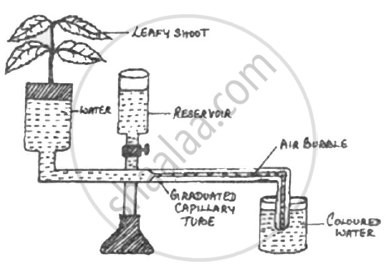
(i) Name the apparatus.
(ii) Which phenomenon is demonstrated by this apparatus?
(iii) Explain the phenomenon mentioned in (ii) above.
(iv) State two limitations of using this apparatus.
(v) What is the importance of the air bubble in the experiment?
(vi) Name the structures in a plant through which the above process takes place.
Advertisements
उत्तर
(i) The apparatus is called Ganong’s Potometer.
(ii) The phenomenon is called transpiration.
(iii) The evaporative loss of water in the form of water vapour from the aerial parts of plants is known as transpiration.
(iv) Two limitations are
- It is not easy to introduce the air bubble into the capillary.
- The twig may not remain fully alive for a long time.
(v) The air bubble helps measure the rate of transpiration.
(vi) Transpiration occurs through roots.
APPEARS IN
संबंधित प्रश्न
Draw a magnified view of the root-hair, and describe, how it helps in the absorption of water from the soil.
Study the diagram given below and answer the questions that follow:

- Name the process being studied in the above experiment.
- Explain the process mentioned in (a) above
- Why is oil placed over water?
- What do we observe with regard to the level of water when this set-up is placed in (1) bright sunlight, (2) humid conditions and (3) windy days?
- Mention any three adaptations found in plants to foster the process mentioned in (a) above
Choose the correct answer:
An example of a selective permeable membrane is __________
Choose the correct answer:
Exudation or bleeding is associated with ___________
The diagram below represents a layer of epidermal cells showing a fully grown root hair. Study the diagram and answer the questions that follow:

The root hair cell is in a turgid state. Name and explain the process that caused this state.
Mention, if the following statement is True or False. If false rewrite the wrong statement in its correct form:
Xylem is the water-conducting tissue in plants.
Inner layer of root hair is made up of ______.
____________ regions are present in a typical root.
____________plants like orchids absorb water vapours from air with the help of epiphytic roots having special tissue called velamen.
They are pipe-like, consisting of a group of specialised cells. They transport substances and form two-way traffic in plants. Which of the following terms qualify for the features mentioned above?
