Advertisements
Advertisements
प्रश्न
Given below is the outline of the human body showing the important glands:

- Name the glands marked 1 to 4.
- Name the hormone secreted by part 2. Give one important function of this hormone.
- Name the endocrine part of the numbered 3.
- Why is the part labelled 1 called the master gland? Which part of the forebrain controls the gland labelled 1?
- Name the gland that secretes the ‘emergency hormone’.
Advertisements
उत्तर
(i)
- Pituitary gland
- Thyroid gland
- Pancreas
- Adrenal gland
(ii) The hormone secreted by the thyroid gland is thyroxine. One important function of this hormone is to regulate basal metabolism.
(iii) The endocrine part of the pancreas is the Islets of Langerhans.
(iv) The pituitary gland is called the “master gland” because it secretes hormones that regulate and control the activity of other endocrine glands. The part of the forebrain that controls it is the hypothalamus.
(v) The gland that secretes the “emergency hormone” is the adrenal gland (specifically, the adrenal medulla).
APPEARS IN
संबंधित प्रश्न
Give technical terms for Group of hormones which influence other endocrine glands to produce hormones
Identify the odd one in the following and mention what the rest is:
Adrenaline is secreted by ______.
Answer the questions after observing the diagram given below.

- What acts as the first messenger?
- Why can’t hormones like catecholamines enter their target cells through plasma membrane?
- Name the mode of hormone action shown in the diagram.
Which hormone is secreted during an emergency situation in a man?
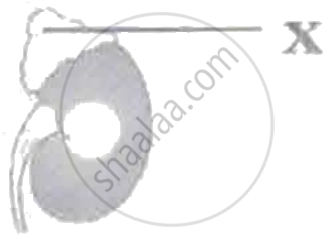
Which gland is represented by 'X' in the given diagram?
Cortisol is secreted by ______.
Which of the following statement is correct about the endocrine glands in human?
Give an account of secretion of various parts of Adrenal cortex.
Give reason.
Adrenaline is often described as the emergency hormone.
