Advertisements
Advertisements
प्रश्न
|
The diagram given below represents the location and structure of an endocrine gland. Study the same and answer the questions that follow:
|
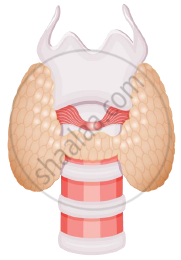
- Name the endocrine gland shown in the diagram.
- Name the secretion of the gland which regulates basal metabolism.
- Name the mineral element required for the synthesis of the above mentioned hormone.
- Name the disease caused due to undersecretion of the above mentioned hormone in children.
- Name the disease caused due to hypersecretion of the above mentioned hormone.
Advertisements
उत्तर
(i) The endocrine gland shown in the diagram is the thyroid gland.
(ii) The hormone that regulates basal metabolism is thyroxine.
(iii) The mineral element required for the synthesis of thyroxine is iodine.
(iv) The disease caused by the under-secretion of thyroxine in children is cretinism.
(v) The disease caused by the hypersecretion of thyroxine is exophthalmic goitre.
APPEARS IN
संबंधित प्रश्न
Briefly explain the following terms: Hormone
Give the exact location of the adrenal gland.
Name the following:
The hormone which increases blood pressure
Write a note on the four different kinds of cell in Pancreas.
Which of the following statements is TRUE for Cushing's disease?
Mary is about to face an interview. But during the first five minutes before the interview she experiences sweating, increased rate of heart beat, respiration etc. Which of the following hormones are responsible for her restlessness?
Correct the following statement by replacing the term underlined.
Tetraiodothyronine is an emergency hormone.
______ is responsible for increase in blood glucose.
Cortex and medulla are the two regions of ______.
Distinguish between the following pair:
Addison's disease and cushing's syndrome (cause and sugar level)
