Advertisements
Advertisements
प्रश्न
|
The diagram given below represents the location and structure of an endocrine gland. Study the same and answer the questions that follow:
|
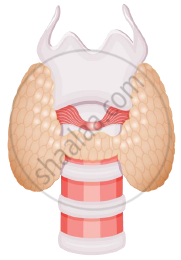
- Name the endocrine gland shown in the diagram.
- Name the secretion of the gland which regulates basal metabolism.
- Name the mineral element required for the synthesis of the above mentioned hormone.
- Name the disease caused due to undersecretion of the above mentioned hormone in children.
- Name the disease caused due to hypersecretion of the above mentioned hormone.
Advertisements
उत्तर
(i) The endocrine gland shown in the diagram is the thyroid gland.
(ii) The hormone that regulates basal metabolism is thyroxine.
(iii) The mineral element required for the synthesis of thyroxine is iodine.
(iv) The disease caused by the under-secretion of thyroxine in children is cretinism.
(v) The disease caused by the hypersecretion of thyroxine is exophthalmic goitre.
APPEARS IN
संबंधित प्रश्न
The catecholamines are secreted by _________.
Gigantism and Acromegaly are due to :
A. Hyposecretion of Thyroxine
B. Hyposecretion of Growth hormone
C. Hypersecretion of Thyroxine
D. Hypersecretion of Growth hormone
Given below is the outline of the human body showing the important glands:

- Name the glands marked 1 to 4.
- Name the hormone secreted by part 2. Give one important function of this hormone.
- Name the endocrine part of the numbered 3.
- Why is the part labelled 1 called the master gland? Which part of the forebrain controls the gland labelled 1?
- Name the gland that secretes the ‘emergency hormone’.
Give the Technical Term: Name the glands which secrete the following hormone: Adrenaline
Give the Technical Term: Name the glands which secrete the following hormone: Noradrenalin
Which of the following statement is correct about the endocrine glands in human?
One of the effects of increased secretion of adrenaline is ______.
The hormone which causes stimulation of sympathetic nervous system is ______.
Hypersecretion of glucocorticoid leads to ______.
