Advertisements
Advertisements
Question
The diagram of an given below demonstrates a particular process in plants. Study the same and answer the questions that follow :
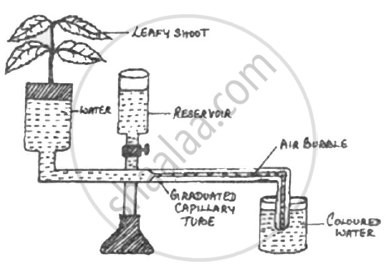
(i) Name the apparatus.
(ii) Which phenomenon is demonstrated by this apparatus?
(iii) Explain the phenomenon mentioned in (ii) above.
(iv) State two limitations of using this apparatus.
(v) What is the importance of the air bubble in the experiment?
(vi) Name the structures in a plant through which the above process takes place.
Advertisements
Solution
(i) The apparatus is called Ganong’s Potometer.
(ii) The phenomenon is called transpiration.
(iii) The evaporative loss of water in the form of water vapour from the aerial parts of plants is known as transpiration.
(iv) Two limitations are
- It is not easy to introduce the air bubble into the capillary.
- The twig may not remain fully alive for a long time.
(v) The air bubble helps measure the rate of transpiration.
(vi) Transpiration occurs through roots.
APPEARS IN
RELATED QUESTIONS
Match the items in column I with those in column II
| Column I | Column II | ||
| (a) | Xylem | (i) | semi - permeable |
| (b) | Phloem | (ii) | permeable |
| (c) | Cell membrane | (iii) | downward flow of sap |
| (d) | Root pressure | (iv) | upward flow of water |
| (e) | Cell wall | (v) | guttation |
Mention whether the following statement is true or false. Correct the false statement by altering the last word only.
Xylem is the water conducting tissue in plants.
Given below is the diagrammatic representation of the transverse section of a part of a plant. Study it and answer the questions that follow:
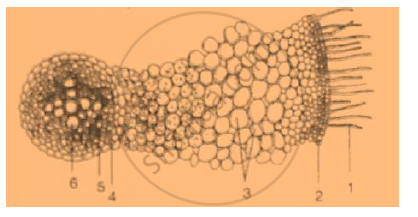
(a) Name the part of the plant that is shown
(b) Label the parts 1 to 6
(c) Write the functions of parts 3 and 5
Process of ascent of sap in plants occurs by ______.
The alongside diagram A shows a root hair growing through the soil particles. Diagram B is the root hair of an aquatic plant.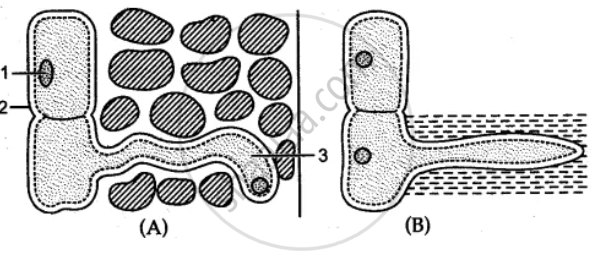
(i) Name the parts 1,2,3.
(ii) Name two substances which enter the root hair. What are their uses?
(iii) By what process do these substances enter the root hair?
(iv) Account for the different shapes of root hairs in the two diagrams.
Draw a cross-section of root showing association of soil particles with root hairs.
Give Technical Term for the following.
Phenomenon of absorption of water by surface attraction.
In the zone of absorption, epidermal cells form unicellular hair-like extensions called ________.
Root hairs are ______
Name the following:
Unicellular outgrowths from the epidermis of roots.
