Advertisements
Advertisements
Question
The diagram below represents a layer of epidermal cells showing a fully grown root hair. Study the diagram and answer the questions that follow:

Mention one distinct difference between the parts labelled A and B.
Advertisements
Solution
|
Cell wall |
Cell membrane |
|
The cell wall of a root hair is freely permeable and allows both salt and water to pass through. |
The cell membrane of a root hair is semi-permeable and does not allow large dissolved salt molecules to pass through. |
RELATED QUESTIONS
The diagram given below represents a plant cell after being placed in a strong sugar solution. Guidelines 1 to 5 indicate the following:
1. Strong sugar solution
2. Cell wall
3. Protoplasm
4. Large vacuole
5. Nucleus
Study the diagram and answer the questions that follow:
(i) What is the state of the cell shown in the diagram?
(ii) Name the structure which acts as a selectively permeable membrane.
(iii) If the cell had been placed in distilled water instead of strong sugar solution which feature would not have been present?
(iv) If the cell in the diagram possessed chloroplasts where would these be present?
(v) Name any one feature of this plant cell which is not present in animal cells.

Process of ascent of sap in plants occurs by ______.
The diagram below represents a layer of epidermal cells showing a fully grown root hair. Study the diagram and answer the questions that follow:

The root hair cell is in a turgid state. Name and explain the process that caused this state.
Study the experimental setup in the figure and then answer the question that follow.
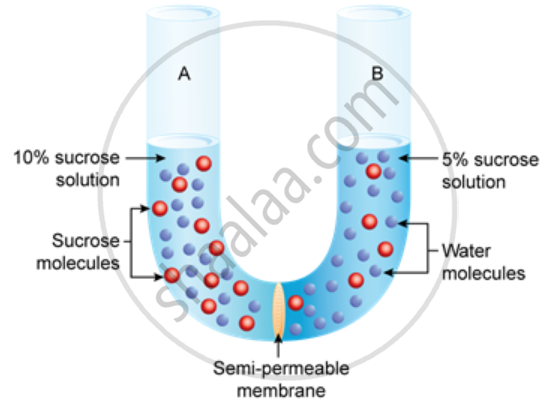
What is meant by 'semipermeable membrane'?
Given below is the diagram of a cell as seen under the microscope after having been placed in a solution:

(i) What is the technical term used for the state/condition of the cell given above?
(ii) Give the technical term for the solution in which the cell was placed.
(iii) Name the parts numbered 1 to 4.
(iv) Is the cell given above a plant cell or an animal cell ? Give two reasons in support of your answer as evident from the diagram.
(v) What would you do to bring this cell back to its original condition?
Draw a cross-section of root showing association of soil particles with root hairs.
Name the following:
The solution outside the cell having lower solute concentration than the fluids.
Plasma Membrane is ______.
Write a note on the morphological structure of the root.
Paheli uprooted a rose plant from the soil. Most of the root tips, with root hairs, got left behind in the soil. She planted it in a pot with new soil and watered it regularly. Will the plant grow or die? Give reason for your answer.
