Advertisements
Advertisements
Question
Study the experimental setup in the figure and then answer the question that follow.
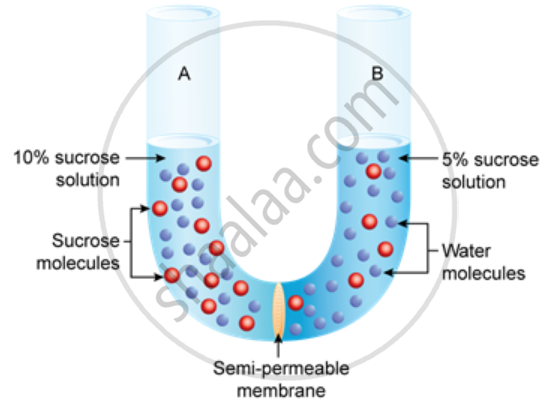
What is meant by 'semipermeable membrane'?
Advertisements
Solution
A semipermeable membrane is a membrane which allows the passage of molecules selectively. It allows a solvent such as water molecules to pass through it freely but prevents the passage of the solute (sugar or salt molecules in solution).
RELATED QUESTIONS
Mention whether the following statement is true or false. Correct the false statement by altering the last word only.
The cell wall of the root cell is a differentially permeable membrane.
What would happen to the root hair of a potted plant if the soil was watered with an extremely concentrated solution of sodium chloride?
Mention whether the following statement is true (T) or false (F) and give an explanation in support of your answer.
Guttation in plants occurs maximum at midday.
Mention whether the following statement is true (T) or false (F) and give explanation in support of your answer.
Dry seeds when submerged in water swell up due to endosmosis.
The diagram given below represents the result of an experiment conducted on two freshly taken shoots of a green herbaceous plant. The lower ends dip in the water.
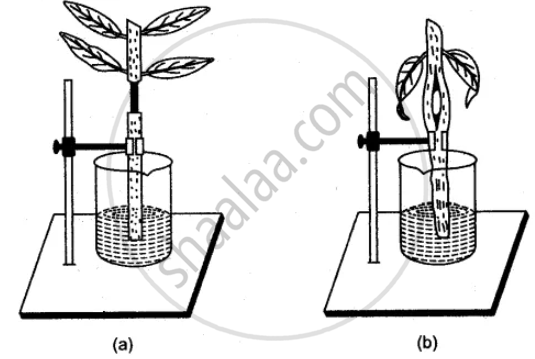
(i) What is the aim of the experiment?
(ii) Some parts of the stem in both the shoots have been removed. Name the conducting tissue in shoot A and in shoot B, that has been removed.
(iii) What are the results of this experiment?
Multiple Choice Question:
Process of endosmosis stops:
In the zone of absorption, epidermal cells form unicellular hair-like extensions called ________.
Outer layer of root hair is made up of ________.
Part of the root that absorbs water from the soil is ______.
Give other name of epidermal cells in roots of plants.
