Advertisements
Advertisements
प्रश्न
Give reason for the following:
If you uproot a plant from the soil, its leaves soon wilt.
On uprooting a plant, its leaves soon wilt. Why?
Advertisements
उत्तर
If a plant is uprooted, the leaves continue to lose water through transpiration, but there is no more water absorbed by the roots. This does not allow compensation for the loss of water by transpiration; hence, the leaves of the uprooted plant will wilt soon.
संबंधित प्रश्न
the exact location of the Lenticels
Draw a magnified view of the root-hair, and describe, how it helps in the absorption of water from the soil.
The diagram given below represents a plant cell after being placed in a strong sugar solution. Guidelines 1 to 5 indicate the following:
1. Strong sugar solution
2. Cell wall
3. Protoplasm
4. Large vacuole
5. Nucleus
Study the diagram and answer the questions that follow:
(i) What is the state of the cell shown in the diagram?
(ii) Name the structure which acts as a selectively permeable membrane.
(iii) If the cell had been placed in distilled water instead of strong sugar solution which feature would not have been present?
(iv) If the cell in the diagram possessed chloroplasts where would these be present?
(v) Name any one feature of this plant cell which is not present in animal cells.

Study the experimental setup in the figure and then answer the question that follow.
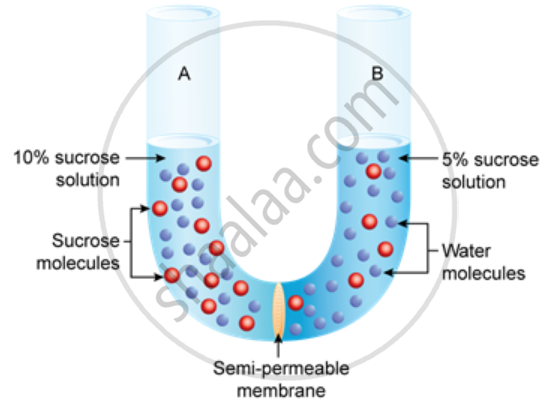
What is meant by 'semipermeable membrane'?
Draw a diagram of the root hair cell as it would appear when a concentrated solution of fertilizers is added near it.
Name the following:
Name the process by which intact plants lose water in the form of droplets.
What is the composition of inner layer of root hair?
Identify the zone in wbkh root hair occurs.
Epiphytic plants like orchids absorb water vapours from air with the help of ______ having special tissue called velamen.
